
Inspiring Older Readers
 posted on 27 Nov 2025
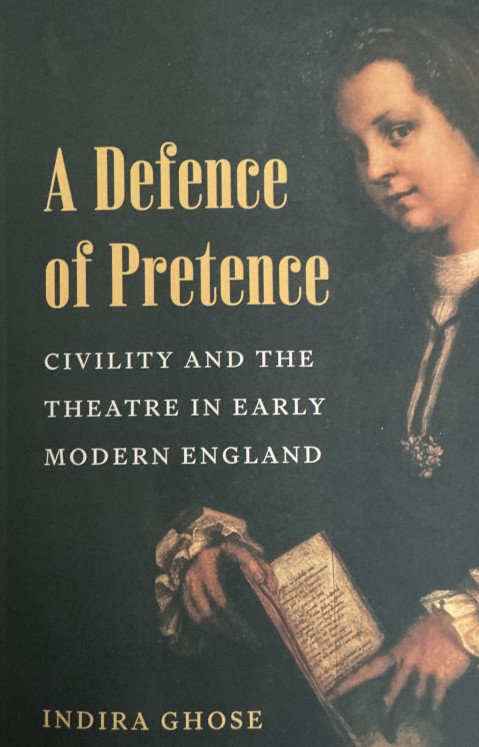
A Defence of Pretence: Civility and the Theatre in Early Modern England by Indira Ghose
It’s always a great pleasure when you discover that what might seem at first sight like a rather esoteric piece of academic research turns out to have immediate, contemporary significance. It’s even more of a thrill when it turns out that the great literature of the past provides us with crucial insights into debates that currently preoccupy public attention. In A Defence of Pretence, Indira Ghose, Emeritus Professor of English at the University of Fribourg in Switzerland, poses the question of what we mean when we use the word ‘civil’ and what we can understand by the concept of civility.
You’d have to have been living in a sealed bunker over the past twelve months not to be conscious of the public debate about the way populations have found themselves at loggerheads with each other – domestically, nationally and internationally. There is a perception that people have found themselves and their opinions drifting away from the centre-ground of social and political thought and finding some sort of fellowship in the extremes of ideology which they then feel obliged to promote and defend at all costs – sometimes rhetorically and sometimes even violently.
But, perhaps unsurprisingly, this is not by any means the first generation to experience such social schisms or the fear of potential chaos that they represent. The starting point of this book is to ask the question of what we mean by the concept of ‘civility’ in our behaviour. Popular usage tends to emphasise the notion of simple good manners and decency (or the absence of it) but it is, Ghose emphasises a much more complex concept with a fascinating history:
“Current debates about civility play out a tension that has been at the heart of discourse and practice of civility throughout history. Civility, this book argues, is radically ambiguous: it can relate either to social distinction or mutual respect, partisan interests or wider community.”
What the author argues – tellingly I think – is that the ‘rules’ of civility tell us a lot about who has designed those rules and whether they are applied as an equalising tool or as a way or re-entrenching privilege. We are invited here to ask:
“…whether civil behaviour is meant solely to serve the self-promotion of an individual or that of a clique, or whether it contributes to the notion of a shared purpose in society.”
Ghose uses the creative plays of Shakespeare, Middleton and Jonson alongside contemporary texts of a philosophical nature that address the meaning of what civility is or what it should be in order to deepen the debate.
“The approach taken in the book is not chronological but thematic. Each chapter addresses a different aspect of early modern civility. Reading key courtesy texts alongside a selection of Elizabethan and Jacobean plays provides an insight into how prescriptive norms are translated into the stuff of fiction.”
One of the most fascinating questions that arises in this study is what role ‘dissimulation’ plays in the warp and weft of social relationships. Civil society, it seems, relies to some degree on how we dissimulate and for what reason:
“In an increasingly fragmented world, where genuine esteem for other members of society is thin on the ground, a pretence of mutual respect might be a course to pursue.”
There’s plenty more in this book to prompt thought and discussion – so don’t be put off by thinking that this is a book for academics alone: politicians of all stripes might benefit from putting a copy on their reading pile.
Available now from Princeton University Press, you will be able to get a copy from your local independent bookshop – who will be happy to order it for you if they don’t have it on their shelves.
Terry Potter
November 2025