Inspiring Older Readers
 posted on 11 Jan 2026
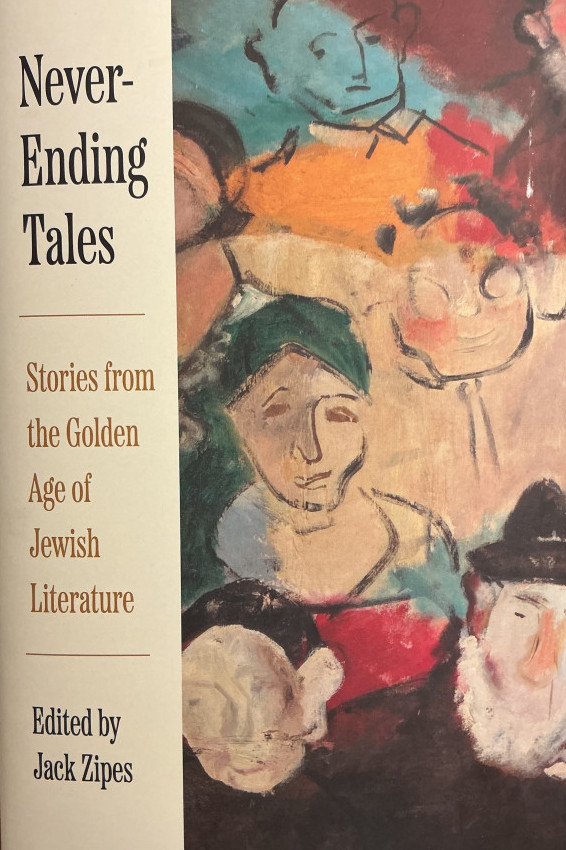
Never-Ending Tales: Stories from the Golden Age of Jewish Literature, edited by Jack Zipes
Here at The Letterpress Project we always find a book authored, edited or introduced by Jack Zipes a matter for celebration. Emeritus professor of German and comparative literature at the University of Minnesota, Zipes has long been a champion of how fiction, storytelling and myth are a crucial way that humanity tries to understand and come to terms with some of the great intractable issues it faces.
That idea is at the heart of Never Ending Tales, a collection of stories about Jewishness, the so-called ‘Jewish problem’ and the seemingly omnipresent spectre of antisemitism that has, catastrophically, reared its ugly head again in the contemporary world.
Zipes has focussed his attention on what he calls ‘the Golden Age of Jewish Literature’ – by which he means stories from the period around the 1870s to the 1930s and featuring writers and settings in Central and Eastern Europe, supplemented by some from England and the United States. To be honest most of these were new to me – I was completely unaware of this ‘Golden Age’ which, of course embraces the time of pogroms and the rise of Nazism – and I have grown up reading the likes of later authors like Bellow, Malamud, Singer and Roth (who I tended to consider my own Golden Age as it were).
So, what is Zipes seeking to do in this anthology? Well, his starting point is the claim that in times of peril and extremis such as that faced by Jews:
“Storytelling and the publishing of stories became a means through which Jews could share their problems among themselves.”
More than that, the act of storytelling and sharing those stories was a direct challenge to the antisemites and “how Jews, whether religious or secular, found ways to survive and to find hope.”
The book has big aims – aims that break the bounds of history and makes the content of these stories as vital today as they were back at the turn of the 20th century. He hopes “to demonstrate how Jewish folk tales and fantasy writing can help us comprehend how deeply the Jewish Question is entwined in cultural history.”
When it comes to the stories themselves, Zipes kicks off with two stories he himself has translated (and which he’s published and analysed previously), ‘The Operated Jew’ and ‘The Operated Goy’ – one explicitly antisemitic story about a Jew seeking to make himself an ‘acceptable’ German (and failing because the almost sub-human Jewishness keeps breaking through despite surgical and psychological interventions) and a second that responds to the original story by reversing the proposition (rather more successfully).
There are over 30 additional stories included in the anthology – some of them very short (and possibly better known, like Peretz’s The Golum from 1908) and others a little longer. The collection ends in fact with two essays, the titles of which will give you a strong sense of what concerns lie at the heart of the book: Theodor Herzl’s The Jewish Question (1896) and Leo W. Schwarz’s The Essence of Survival (1935).
This is unlikely to be a book that you’ll pick up and read from cover to cover in one setting but it certainly is one that you will be able to return to again and again. And, for students and academics interested in trying to understand the terrible history we risk rerunning, this would be an invaluable study aid.
Available now from Princeton University Press, you will be able to get a copy from your local independent bookshop – who will, of course, be happy to order it for you if they don’t have copies on their shelves.
Terry Potter
January 2026