
Inspiring Older Readers
 posted on 29 Jan 2026
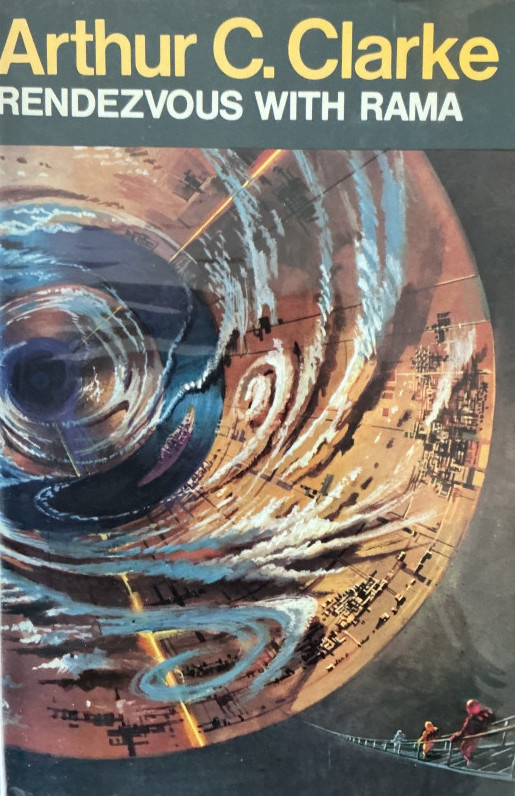
Rendezvous With Rama by Arthur C. Clarke
I have written before on this website about the fact that, as a reader, I have an ambiguous or even problematic relationship with science fiction as a genre. I have latent sense that I really should enjoy it but I struggle to find authors that don’t just make me slam the book closed after a few pages.
My problems are really with what I think of as hardcore or traditional science fiction, the sort that’s about space, space travel, other worlds and alien species. I can’t easily draw a distinction between this sort of fiction and the other worldly fantasy stuff full of dragons, elves and wizards – I somehow find it all just a little…..embarrassing.
So, what made me go against my past experiences and prejudices and try Arthur Clarke’s Rendezvous With Rama? Well it’s a bit of a roundabout route but I was intrigued by the discovery in 2017 of an interstellar object that was making its way through our solar system and this object, given the name ‘Oumuamua, was enigmatic enough to get people speculating that this might not be an entirely natural object. Could it be, as some scientists speculated, our first encounter with an artificial, non-human object? Well, the jury remains out on this question but it didn’t stop the UFO obsessives from getting over-excited and I have recently been reading some of the crazier fringe theories about what ‘Oumuamua portends. But then I discovered that in 1973 Clarke had imagined a very similar scenario in his novel and I was tempted by this into rooting out my copy from the dusty back shelves of my collection.
It’s 2131 and Earth’s protective detection system has identified the arrival of an interstellar object that they name Rama and which seems to be deliberately making its way towards the Sun. An expedition is sent to intercept it and it is soon established that this is no ordinary comet or meteor – it is in fact a huge metal cylinder that initially seems to be entirely lifeless.
What then follows is what is discovered inside this craft by those sent to explore the interior. I don’t really think it’s a good idea to reveal what is found because without the pleasure of sharing that exploration with the characters, there’s not much more to be gained by reading the book. Clarke is brilliant at describing for us the often disorienting experience of encountering an environment so extraordinarily alien that it turns our expectations on their head.
As Rama drifts ever closer to the sun the transformation of the interior accelerates and springs new surprise after new surprise until the crew exploring the vessel are finally required to evacuate. Clarke delivers the final twist when we discover that the proximity to the Sun is merely a refuelling manoeuvre designed to power the next phase of the vessel’s journey out into interstellar space for a rendezvous elsewhere.
It felt very much that this was a novel written by a scientist to please others with a similar scientific bent rather than someone trying to test out philosophic ideas or social issues. What you won’t find here is complexity of character, compelling dialogue or any real sense of jeopardy: it very much feels as if you’re meant to be fascinated not awed by the sheer wonder of an alien vessel that may or may not be alive or sentient. This is a novel that dangles possibilities without really offering anything concrete – other than the certainty that we’re not alone in the universe.
So my search for the sci-fi novel that’s going reveal its mysteries to me continues – oddly enough, I still don’t want to give up on them and I really want to believe I can be converted.
You won’t struggle to find paperbacks at affordable prices – but if you want a first edition hardback you’re going to have to dig deep to afford one.
Terry Potter
January 2026