
Inspiring Older Readers
 posted on 03 Mar 2026
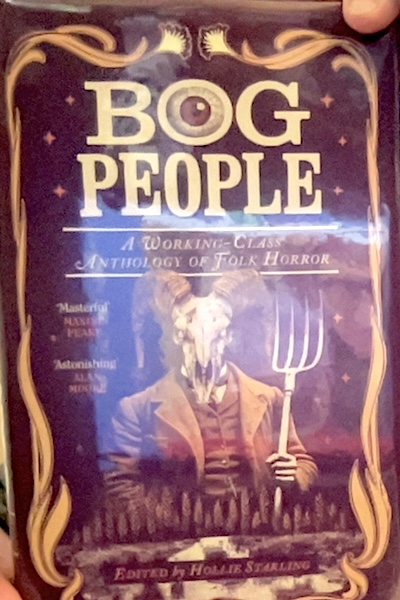
Bog People, edited by Hollie Starling
Bog People: A Working Class Anthology of Folk Horror was published to very favourable reviews in late-2025. But this isn’t just a new collection of short weird stories; it has rather greater ambitions than that, which I’ll explain in a moment.
Folk horror has become enormously popular in recent years, driven by online enthusiasm and a powerful nostalgia for the 1970s when the genre flourished in literature, film and TV. Writers such as Alan Garner, Susan Cooper, John Gordon, Peter Dickinson and Penelope Lively; films such as The Wicker Man, Witchfinder General and Blood on Satan’s Claw; and TV dramas such as The Owl Service, Children of the Stones, The Changes and The Stone Tape – these and more now form an ever-expanding canon of folk horror. Some purists, I noticed recently, also distinguish between folk horror and folk gothic; there is even a sub-genre called ‘hauntology’ which I think refers to a feeling the present is constantly haunted by unquiet pasts, or perhaps by already lost futures. I’m not sure.
So what does the term folk horror mean exactly when applied to literature? True adherents could and probably do argue all day about this, but I take the key characteristics to include isolated rural settings, folklore, superstition, paganism, occult ritual, witchcraft, ancient traditions and the power of myth. The idea of the ‘time-slip’ – fractures or collisions in time that bring the modern and ancient together – which was a strong feature of some of the finest novels of the 60s and 70s perhaps now has a less pronounced role in the genre.
But according to the editor of this collection, Hollie Starling, class discrimination and class conflict are also central to the genre, especially as they exist between landed interests (local gentry, aristocratic elites, the ‘big house’) and working class communities (agricultural labourers, peasants, the poor), and because of this she believes that rather than merely being the subjects of folk horror, people from working class backgrounds should be producing their own variants of the genre. Hence this anthology.
So what of the stories themselves? Well, perhaps like most anthologies, they are uneven, but the best are very good indeed. In The Ossuary, a depressed, ageing and ill woman is the volunteer guide at an ossuary in the crypt of an Essex church. She is estranged from her son who has come to despise her small-mindedness and racist attitudes, but they achieve something approaching a reconciliation – silent and despairing though it is – as she lies in hospital. It is a story almost untouched by folk horror but rich in working class sensibility and regret and confusion. By stark contrast, Perpetual Stew – perhaps as nearly ‘classical’ a folk horror story as one could wish for – concerns the death and head-of-family succession rites in an isolated former pit village. It would make a superb short film or TV drama, partly because it could be set at almost any period, including a dystopian near-future.
Eldritch is a good idea. We are reading an unpublished 2012 article by music journalist Simon Payne, commissioned by music paper Cult Sounds Monthly to mark the fortieth anniversary of the legendary second and final LP, Eldritch, by Heptagonal Sons, a mysterious, possibly occult-influenced prog-rock band. The article-within-a-story brought to mind an updating of the kind of device that writers like Poe and M. R.James have favoured. Each of the seven tracks on the record is analysed in close detail and the journalistic prose of the piece is convincing in both style and content, reading like an article from the kind of publication one would imagine Cult Sounds Monthly to be. I thought the tone and detail of this one were brilliantly imagined but that the ending wasn’t quite climactic enough. I had been hoping for something a bit more awful.
The other two stories I would single out for mention both push the boundaries of the genre while succeeding outstandingly on their own terms. Hollie Starling’s own story, Yellowbelly, is a tour de force in its reframing of folk horror. Beautifully written, sharply focused and audacious in its imagining, not only does it have a working class perspective at its heart, it also casually repositions something of 80s and 90s ‘cyberpunk’ fiction in the context of contemporary concerns regarding AI, poverty, the gig economy and the cost-of-living crisis. I couldn’t quite decide whether this or Perpetual Stew was the star of the collection.
The other, The Hanging Stones, is a raw, powerful story about the long shadow cast by family bereavement, emotional abuse and alcoholism and it has only the lightest touch of folk horror in that the events it turns on may or may not be supernatural. In its tough emotional heft I thought it had echoes of so-called ‘dirty realism’ writers like Raymond Carver and Tobias Wolff.
This accounts for about half the stories in the collection and I’m afraid I didn’t think the others approached anything like the same quality. But I would certainly read more. The idea of ‘working-class folk horror’ is clearly too good to let fizzle out after just one collection and the very best of what’s here suggests that Starling may be onto something. Let’s hope so: here’s to a second volume.
Alun Severn
March 2026
Related reviews elsewhere on Letterpress:
Alan Garner’s The Owl Service – at Fifty
John Gordon, Dennis Hamley, Penelope Lively: More children’s fiction from the 1960s & 70s
Susan Cooper’s The Dark is Rising sequence and The Dark Is Rising by Susan Cooper
Small Shadows Creep, selected by Andre Norton
The Weirdstone of Brisingamen by Alan Garner