
Inspiring Older Readers
 posted on 22 Mar 2026
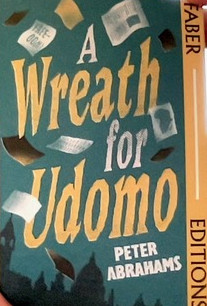
A Wreath for Udomo by Peter Abrahams
I only recently became aware of the Faber Editions series, attracted by their beautiful design and high-quality production. Faber says that it is rediscovering lost gems from its archive and bringing back into print ‘radical literary voices’ that ‘speak to our present’.
I’m a sucker for ‘rediscovered’ classics, especially when they are as stylishly done as these and I’m gradually working my way through a first clutch of titles that I made sure were on my Christmas list – starting with A Wreath for Udomo, an important novel of the African freedom struggle by Peter Abrahams, first published in 1956.
Peter Abrahams was born in Vrededorp, Johannesburg in 1919, the son of a black African father and a white French mother, destined by South Africa’s infamous race laws to grow up legally designated as neither white nor black but ‘coloured’. His father died early and Abrahams had an impoverished childhood, but won a scholarship and was educated at a number of mission schools before enrolling as a seaman and beginning the long journey that would see him resettle in London in the mid-1940s, where he worked as a journalist. A committed writer and a lifelong activist against apartheid and colonial oppression he was one of the organisers of the Fifth Pan-African Conference held in Manchester in 1945 and throughout the 1950s was at the heart of African emigré politics in London, moving in circles that included future African leaders such Kwame Nkrumah, Jomo Kenyatta and Hastings Banda and liberation theorists such as George Padmore. That experience profoundly informs this novel.
Abrahams never enjoyed the eminence of other more famous South African novelists, such as Nadine Gordimer and Alan Paton, but he is now increasingly recognised as one of the pioneers of African literature. Nadine Gordimer said of Abrahams: ‘[He] is an African writer, a writer of the world, who opened up…a path of exploration for us, the writers who have followed the trail he bravely blazed’; the Sunday Times described him as ‘the forerunner of an entire school of African literary art’; and his 1946 novel, Mine Boy, is now recognised as perhaps the first novel by an African writer to gain worldwide attention.
Abrahams’ personal experience and political perspective may well be unique in African fiction of the 1950s. For A Wreath for Udomo is an anti-imperialist novel written at the very beginnings of decolonisation, by an African man who was writing from within the liberation movement. This would be reason enough to read it but Abrahams is also unflinchingly analytical, sceptical of ‘heroic leadership’ and personality cults, and prescient in identifying the profound problems that would confront newly independent African nations – not least impoverishment, under-development, internal division, human failings and compromised ideals, but also the long-term damage and social deformity of colonialism and rapacious foreign business interests. In all of these aspects it is a book that can and does still surprise.
It opens atmospherically in a bitterly cold London winter in the 1950s, where Michael Udomo, recently arrived from Africa, is tentatively finding his feet in the emigré community. It is largely his trajectory and that of a handful of comrades that we follow as the years pass and they make their way back to lead liberation movements in Africa.
The novel is not without its flaws, however. Its dialogue and characterisation can be rather wooden and there is a tendency to engage in rather lumpy interior monologues as a means of explaining characters’ motives and actions. But these faults are largely a consequence of the scale of Abrahams’ ambitions, I think, and could perhaps have been avoided only by writing what would inevitably have been a longer and more ‘procedural’ novel in which the politics and strategies of liberation were more fully explained. But such a novel would probably have struggled to find both a publisher and readers. Instead, Abrahams seeks to convey these complex private, political and public worlds with a lighter and more impressionistic touch which doesn’t always quite succeed.
I think it would also have been helpful if the novel had had a more detailed introductory note putting its particular historical moment in context. For instance, if you want to understand the role of the ‘colonial committees’ adopted in the administrations of various Commonwealth countries during the 1950s and how and why these structures operated you’ll need to do a bit of online searching, as I did. This is a book whose hinterland needs a bit of filling in in order to get the most out of it.
Abrahams eventually settled in Jamaica, where he died, aged 97, in 2017. What only became evident later, however, is that he was murdered by a man who was stealing from him, the husband of a carer or aide of some kind. An extraordinarily sad end to a long and valiant life. There is reason, then, to be doubly thankful for this splendid new edition of A Wreath for Udomo and its reaffirmation of Peter Abrahams’ central importance in the development of African literature.
Alun Severn
March 2026