
Inspiring Older Readers
 posted on 31 Mar 2026
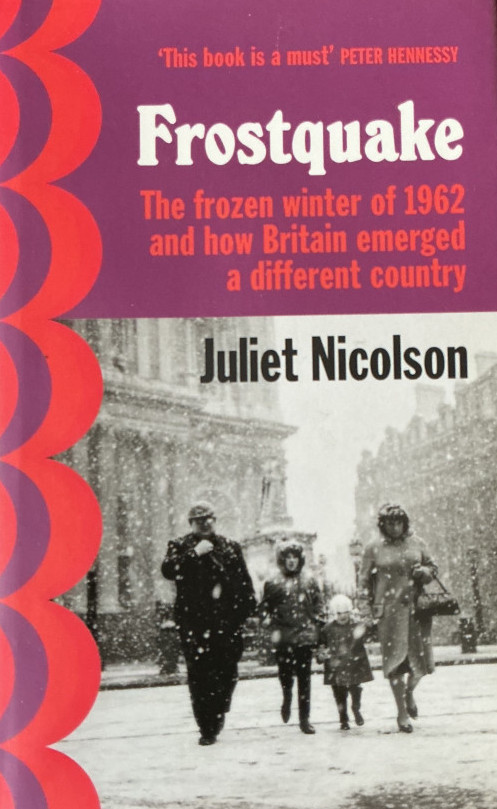
Frostquake by Juliet Nicolson
Juliet Nicolson, the granddaughter of the famous literary critic, Harold Nicolson and daughter of Nigel Nicholson, the publisher, was eight years old when the brutal winter of 1962 hit the UK. I was also eight at the time and I was living in inner city Birmingham rather than the (albeit crumbling) majesty of Sissinghurst but the savagery of the cold was, in many ways, a national trauma affecting all ages, cultures and social classes. I retain memories of frozen pipes, ice on the inside of the windows, mountainous banks of snow flanking pavements hastily scraped clear and the misery of a balaclava gone soggy around the mouth.
So given that Frostquake: The frozen winter of 1962 and how Britain emerged a different country stirs so many personal memories for me, it’s hardly surprising that I was drawn to read it. But this turns out to be a lot – a whole lot – more than just a book about an extreme weather event because Nicolson has a much greater scheme in mind. What she postulates is that this extraordinary few months of winter in late 1962 and early 1963 actually marks a moment that is pivotal in a series of social and cultural changes that were dragging the UK into the ‘modern’ world of the 1960s (and all that it came to represent) and out of the conservatism and deprivations of the post war world of the 1950s.
And, to be honest, the social change element rather overtakes the meteorological intentions and this becomes more a book about key moments in politics, culture, social structures and entertainment rather than a real examination of the privations suffered by different strata of society during an arctic winter. That’s not to say that the sections relating to such issues as the decline of the Prime Minister, Harold Macmillan as a political force, the Profumo Affair or the rise of The Beatles aren’t in themselves interesting but I would have liked to have a better researched analysis of that weather phenomenon than we get.
The book also begins to develop a very strong autobiographical strand about a third of the way through and we start getting more about the author’s family, her perception of them and a snapshot of the now, rather ghostly, world of Sissinghurst. So suddenly we have virtually three books in one: the story of the great freeze, the story of Britain on the cusp of change and an autobiographical memoir. Maybe three separate books would have served better than the one?
It is also fair to say, as I’ve read suggested elsewhere, that any real link between the social and cultural upheaval taking place and a few months of wickedly bad weather isn’t really firmly established and doesn’t really stand too much analysis. In truth, I think, the coincidence of dates between the big freeze, the big thaw and the thawing of social deference and conservatism and the subsequent flood of creativity is simply an eye-catching device – but one which is entirely genial and ultimately pleasing enough to read.
I found this an untaxing and gentle read which filled in a few gaps for me around headline events I was too young to understand at the time and that I’ve never subsequently gone back to explore in more targeted literature. But don’t expect complex or nuanced interpretations here because it’s not that kind of book.
Both paper and hardback copies are easy enough to find and are not expensive. At well under £10 it’s surely worth an afternoon or two’s reading time.
Terry Potter
April 2026