
Inspiring Older Readers
 posted on 04 Jun 2026
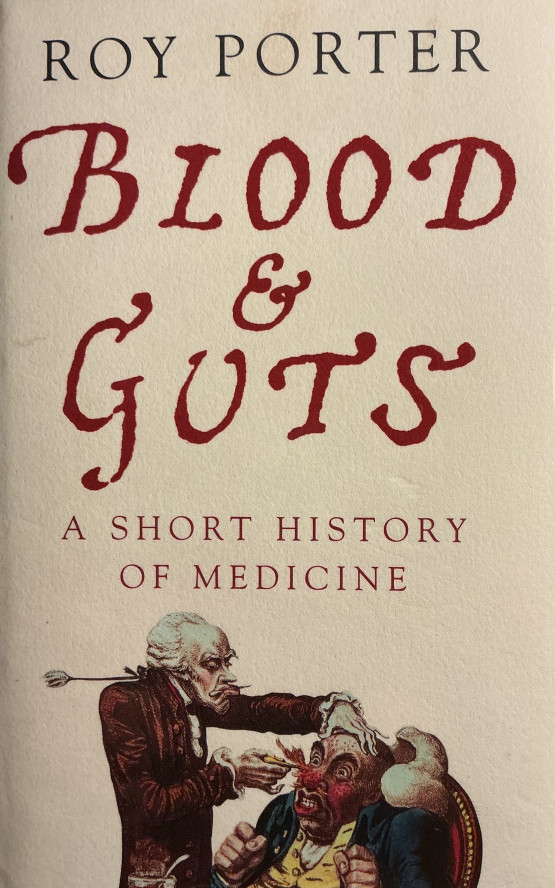
Blood & Guts: A short history of medicine by Roy Porter
I have written before on this site of my admiration for the writings of Roy Porter and I make no apologies for reproducing the opening section of my review of his final book, Flesh in the Age of Reason. In this piece I said of him:
“Porter had an astonishing brain and a genuinely awesome capacity for reading, complex interpretation and an admirable capacity for easy communication. Captivatingly for me at least, he also had a fundamentally dissenters approach to fusty establishment academia. You could argue that Porter was almost a punk academic who lived a fast, intense life and died tragically young in 2002 at the age of just 56. You’re left wondering just how he mastered so much knowledge and understanding across so many different areas – history, medicine, literature, philosophy, geology to name a mere handful.”
So, I was delighted to pick up a copy of Blood & Guts which is literally what its subtitle suggests – a short history of medicine, occupying barely more than 150 pages. The notion that a subject so extraordinarily complex and dominated by scientific and technical specialisms can in some way be effectively captured in such a concise way seems fanciful. But this leaves the dazzling skills of Roy Porter out of the equation: the man was a consummate communicator who never lost sight of the fact that he was writing to be understood not writing to impress through obscure complexity.
Chandak Sengoopta who teaches in the Wellcome Unit for the History of Medicine, University of Manchester reviewed the book for The Independent back in 2002 exactly captures what Porter lays out before us:
“In eight beautifully crafted chapters, Porter deals with the evolution of diseases, the development of the medical profession, the growth of anatomy, physiology and therapeutics, the history of hospitals and the growing socio-political significance of medicine. Each of these topics has been addressed in isolated ways by scholarly monographs, but this little book provides the big picture that one must master before approaching those tomes.”
What I think is brilliant here is that Porter doesn’t put the institutions of medicine or the hugely impressive technical breakthroughs or the doctors and medics at the forefront of his history but instead his focus is on the people that medicine is for. As if to emphasise this, his starting point is the endless battle of humanity against the constant onslaught of disease – a battle we’re doomed to continue fighting (and often losing) despite our ingenuity.
Who, then, is this book for? It’s certainly for the interested lay reader (like me) but it’s also for the specialist who needs to revisit the fundamentals. By stepping back and finding the space between a full social history of medicine and a technical or scientific monograph written in a language that means little to the lay reader, Porter has found a niche that casts light on the interests of all potential readers.
I can’t do any better than to give the final judgement to Chandak Sengoopta, who hits the nail directly on the head when he says of Blood & Guts:
“…this is an impressively researched, generously imagined and superbly written introduction to a grand subject affecting us all.”
Paperback copies can be picked up for around £5 – an absolute bargain.
Terry Potter
June 2026