
Inspiring Older Readers
 posted on 21 Jul 2026
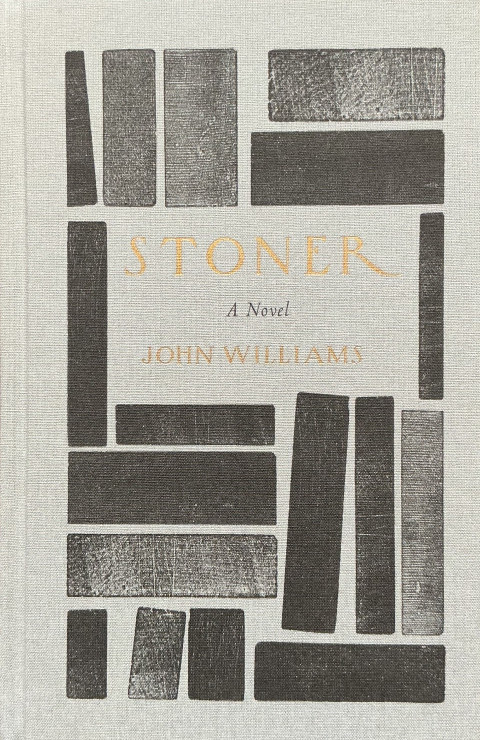
Stoner by John Williams
How does a novel become a ‘hidden gem’ or ‘cult classic’? It’s a status that can probably be endlessly debated and plenty of people will have their own view of the criteria that apply to which books get given the label. However, I’m willing to bet that there will be plenty of unanimity around including John Williams’ Stoner in the ‘hidden gem’ or ‘cult novel’ club.
Williams published Stoner in 1965 and it was greeted with mild critical interest and moderate sales and, as happens to plenty of other books, it then drifted out of print. Williams himself had a modest enough career, publishing a second novel, Butcher’s Crossing (reviewed here) but having more success in 1972 with his story of Ancient Rome, Augustus, which was the joint winner of The National Book Award. Two decades later he died having released nothing more.
This, you’d be entirely forgiven for thinking, was pretty much all there is to say about a decent but ultimately modest output. But no. In the early years of 2000, Stoner was republished with the serious and articulate championing of the Irish master prose stylist, John McGahern and it became, as Julian Barnes wrote in The Guardian (2013):
“A quite unexpected bestseller. A bestseller across Europe. A bestseller publishers themselves could not quite understand. A bestseller of the purest kind – one caused almost entirely by word-of-mouth among readers.”
And the reputation of Williams and of Stoner has continued to flourish, moving him from a virtual unknown to someone whose name is now frequently included as one of the very best prose stylists of 20th century US fiction.
But it’s very easy to see why this book slipped past so many people when it first appeared and, to be fair, why even publishers found its runaway success hard to get to grips with. It’s actually a book that celebrates the average and captures the inevitable small-scale failures of the normal life experienced by so many – there’s no great tragedy, no flash-bang action and no overwrought drama – and it seems to defy the idea that capturing a reader’s attention needs bells, whistles and flags waving constantly.
The book chronicles the life of William Stoner, born into a dirt-poor farming family, who through an opportunity to attend college, gets captured by the wonder of literature. He comes to believe that his destiny is to become an academic and lecturer, passing this sense of wonder at the ability of literature to change people and, indeed, change the world. It’s a vocation that, despite all the petty disappointments that follow in his life, he never abandons and dies believing that the academic life was the only one that was steadfast.
Along the way we follow Stoner as he refuses the draft in order to stay in education, makes a terrible marriage, falls foul of a malicious colleague determined to sabotage his career, has a briefly wonderful but ultimately failed love affair.
Yes, there’s a sort of sadness in Stoner’s constant sense of loss – nothing ever quite works out for him – and it would be easy to conclude that Williams is seeking to paint the life of a failure but, as Barnes useful identifies, the author thought quite differently:
Though he is allowed small victories towards the end of the novel, they are pyrrhic ones. The pains of lost and thwarted love have tested Stoner’s reserves of stoicism to the full; and you might well conclude that his life must be accounted pretty much a failure. But, if so, you would not have Williams on your side. In one of his rare interviews, he commented of his protagonist:
“I think he’s a real hero. A lot of people who have read the novel think that Stoner had such a sad and bad life. I think he had a very good life. He had a better life than most people do, certainly. He was doing what he wanted to do, he had some feeling for what he was doing, he had some sense of the importance of the job he was doing … The important thing in the novel to me is Stoner’s sense of a job … a job in the good and honourable sense of the word. His job gave him a particular kind of identity and made him what he was.”’
This is a book I found myself entranced by from the very first page. The subtlety of the story is brilliantly achieved but the real clincher for me is the prose style, an almost intoxicating or mesmerising clarity of expression and description that seems to fit like comfortable clothes.
I’m leaving the last words to Julian Barnes, a novelist himself recognising another at the peak of his powers:
… it is a true “reader’s novel”, in the sense that its narrative reinforces the very value of reading and study.
Copies are easily available now in cheaper editions – paper and hardback – but if you want an original first edition (and I certainly would), you might need to negotiate an extension on your mortgage.
Terry Potter
July 2026