
Inspiring Older Readers
 posted on 28 Jul 2026
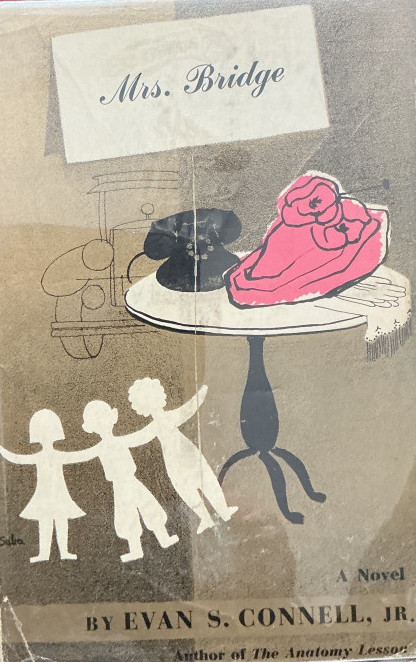
Mrs. Bridge by Evan S. Connell Jnr.
I can’t help but think of Evan Connell Jnr. (1924 – 2013) as a rather unfortunate writer; unfortunate in as much as he had the bad break of writing at the same time as a clutch of other great American writers – Updike, Roth, Bellow – whose reputations overshadowed him. As a result, especially in the UK, much of what Connell wrote landed without much of a fanfare and his quality as a prose stylist has often been overlooked. Even an endorsement from Dorothy Parker – “a writer of fine style and amazing variety” – hasn’t been enough to make him a familiar name even amongst those who are committed readers.
However, I’m glad to say that over time an appreciation of his work – especially his first novel, Mrs. Bridge (1959) – has grown steadily and in 2009 he was nominated for the Man Booker International Prize. I rather stumbled over Mrs. Bridge quite a while ago and found myself completely entranced by a novel in which, I have to admit, not a lot happens. When I came to reread it this time around, I discovered that saying nothing much happens is really a travesty because at its heart it is a story of quiet desperation and the passing into history of old values in the face of a new, rising generation that has its own mores.
The narrative of the book is told in a series of vignettes largely through the eyes of India Bridge, a sort of middle-aged matron who is part of the upper middle class in the booming suburbs of Kansas between the 1920s and 1940s. She is married to the mostly absent and laconic, Mr. Bridge, himself a mainstream Republican-style conservative, has a maid/home help she can’t possibly manage without and three children who are growing up to show all the signs of rebellion against the stuffy sense of propriety and convention that Mrs. Bridge so desperately seeks to cling to.
Ten years after Mrs. Bridge was published, Connell followed it with a bedfellow, Mr. Bridge (1969) which I think it’s fair to say has garnered far fewer expressions of delight than the original. However, in the citation that came with the nomination for the International Booker, both novels were mentioned and described in this way:
“Connell’s novels Mrs. Bridge (1959) and Mr. Bridge (1969) are bittersweet, gently satirical portraits of a conventional, unimaginative upper middle-class couple living in Kansas City from the 1920s to the 1940s.”
And although it’s certainly true that they are almost affectionately satirical, I was left with quite a different mix of emotions. Here was a woman dealing, in an increasingly tense way, with a couple of half-formed and conflicting truths: that her children will belong to an age where the values she has grown up with will no longer hold sway and, perhaps even more devastatingly, the realisation that her life has been wasted or unfulfilled.
Every now and then the satire cuts through, mainly in the form of the emotional stuntedness of both her and her husband towards their ‘friends’ and their children. I could pick out several examples of the clever way Connell steers us to see this without ever quite losing the unexpected and unaccountable underlying sympathy we retain for Mrs. Bridge – but that would simply be spoiling it for you.
This is a slow read but not an arduous one. It’s slow in the very best way because you really will want to take your time with prose of such quality. This will allow you to spend your time, not just with the high quality of the writing but it will also let you explore the delightful nooks and crannies that Connell excavates in this world the Bridges have created – a world that strains to retain a still surface in order to disguise the suppressed passions that lie beneath.
Available in paperback (there’s a rather elegant Penguin Modern Classic) for under £10, this book is an absolute joy.
Terry Potter
July 2026