Inspiring Older Readers
 posted on 13 Aug 2026
The Surprising Story of Penguin Illustrated Classics
I’ve grown up as a reader with the presence of Penguin Books as a constant, even reassuring, backdrop. They have been a sort of compass or guide to my reading since I was in my mid-teens and now, over fifty years later, they still provide inspiration, revelation and something of a quality benchmark: if it’s published by Penguin it must be worthy of consideration.
Most people with any interest in books and reading will know the outline of the story about how Penguin, under the guidance of Allen Lane, pioneered the cheap, good quality paperback that was always careful to maintain literary quality. That was back in 1935 and since those early days they have developed series after series of themed and repackaged books that put a premium on being inventive when it comes to art, design and format. Classics, modern classics, poetry, fine art and for children a distinct subsidiary, Puffin, and for non-fiction, the Pelican brand.
And there’s a huge back-catalogue to explore which shows the constant evolution of the Penguin book. One of the fascinating things to discover is which of the experimental repackagings has lasted and which ones died-out (failed commercially) or evolved into something else. The story of the Penguin Illustrated Classic demonstrates that not everything Penguin touched turned to gold – even if the inspiration behind it had all the best motives.
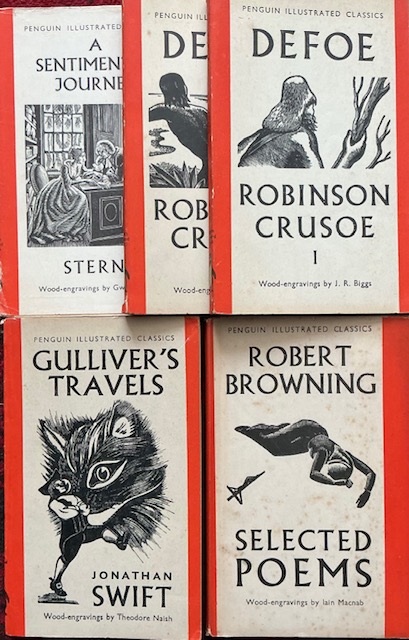
In 1938, just three years after Penguin coming onto the market, Lane was persuaded to develop a series of reprinted, out-of-copyright, classic texts illustrated by wood-engravings from noted artists of the day. Woodcuts as a means of book illustration was having something of a boom – perhaps led by the likes of Frans Masereel in Germany and Lynd Ward in the USA. On a wave of enthusiasm with the idea that this might lead them to an expanded audience who might view the paperback as a more sophisticated purchase, they issued ten – yes, ten – books on one day: Pride and Prejudice by Jane Austen, A Sentimental Journey by Laurence Sterne, Some Tales of Mystery and Imagination by Edgar Allan Poe, Walden by Henry David Thoreau, Selected Poems by Robert Browning, Robinson Crusoe by Daniel Defoe (in two volumes), Typee by Herman Melville, The Story of My Heart by Richard Jefferies, and Gulliver’s Travels by Jonathan Swift.
To emphasise their quality, these were paperbacks with their card covers enveloped in a removable paper jacket similar to that you’d find on a hardback. Each book would carry a dozen full and part-page woodcuts, with the name of the artist prominently on the front of the jacket emphasising this was not simply adornment to a marriage of art and literature.
But bold moves of this kind need both a touch of luck and good timing – two conditions that completely deserted the Illustrated Classics series. The date of May 1938 perhaps gives you a clue: the reading public of the time were becoming less interested in looking back to classic literature and a lot more interested in the potential juggernaut of a world war that seemed to be hurtling towards them. The titles they made available seemed unattractive and dull in such a febrile environment and the woodcut process they were seeking to showcase didn’t easily lend itself to the cheap printing paper relatively budget paperbacks used.
Sales figures were poor as a result and the idea was almost immediately shelved and Allen Lane clearly learned an important lesson as I think the subsequent success of Penguin Modern Painters demonstrates (https://www.penguinfirsteditions.com/index.php?cat=mainMP)
Over the years I have accumulated five of the titles but they have become increasingly hard to find, especially with they jackets. If I can pick up the others I will because I’m actually quite fond of the format despite its obvious shortcomings.
I am indebted to this 2012 article by Alyssa O’Connell in The Ransom Center Magazine (https://sites.utexas.edu/ransomcentermagazine/2012/11/29/penguin-illustrated/) which filled in a number of gaps in the story that I didn’t previously know.
Terry Potter
August 2026