Inspiring Older Readers
 posted on 18 Aug 2026
Two novels by Jacques Chessex
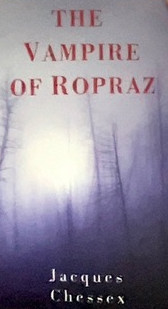
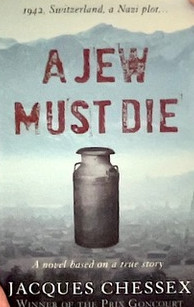
When I reviewed Gert Hofmann’s Veilchenfeld recently (here) I spoke of a later generation of European novelists who seemed to be writing in the long, inescapable shadow of the Holocaust but approaching it more obliquely, as if haunted by its presence rather than writing explicitly about it.The Swiss novelist Jacques Chessex is another of the writers I had in mind and I so I decided to reread the only two slender novels I have by him: The Vampire of Ropraz, first published in 2007, and A Jew Must Die, first published in 1973.
They are quite different, and I think one is of far greater significance than the other, but they are worth considering together because they help illustrate both his style (short, austere, unflinchingly observed) and the subjects (hatred, superstition, cruelty – what might be described as the social and psychological circumstances that made the Holocaust possible) that he so distinctively and sometimes controversially made his own.
The Vampire of Ropraz takes place in 1903 and is set in a small village in the Jura mountains – in fact, the village that Chessex moved to in May 1978. The novel concerns the disinterment, sexual mutilation and dismemberment of three recently buried young women, at sites separated by just a few miles; events that are described – and I’ll be perfectly honest – in what I thought was gratuitously graphic and explicit detail. I think I understand why, but even so, it is stomach-churning stuff. The crimes have aspects of necrophilia, vampirism and cannibalism and it doesn’t take long for people to conclude, in keeping with centuries of folklore and superstition and atavistic fears, that a vampire is hunting in their midst.
Nor, really, does it take all that long for a pitiful, snivelling suspect to be identified – Favez, a young man, an alcoholic with what we would now call learning difficulties, guilty of mutilating and committing sexual acts with neighbours’ farm animals, but no more a vampire or a cannibal than anyone else in the community. He is tried and convicted – perhaps a useful scapegoat – locked up and subjected to primitive psychiatric care. In 1915, he manages to disappear. There are subsequent unconfirmed sightings but he is never found. The local families of the three girls cope with their trauma as well as they are able.
These events did happen. In 1978 when Chessex moved into the village the grave of the first victim was still marked. But the conclusion he brings this nightmarish fable to (and I am deliberately not revealing it) is a flourish of pure invention. I couldn’t help but be impressed, but I did also feel that in the process what had gone before was perhaps being somewhat misused. I have now read it twice and while I think it may be slighter than his other work, there is still much in it of Chessex’s vision and technique that fascinates.
But A Jew Must Die is another matter entirely: it is superb. The events described take place on the 16th April 1942, a few days before Hitler’s birthday and the setting is Payerne, the historic Roman town in the canton of Vaud, western Switzerland, where, incidentally, Chessex himself was born. Payerne is a prosperous town of respectable burgers – bankers, business people, merchants, farmers, cattle dealers – with a small, well-off Jewish community.
But not even Switzerland has been immune to the economic turmoil – industrial collapse, inflation, unemployment, poverty – sweeping Europe and in Payerne, a tiny group led by one Fernand Ischi – who runs a local garage but believes he will be Payerne’s strutting Gauleiter once Hitler triumphs – has decided that in order to send a birthday message to Hitler and a bloody warning to all Jews everywhere, a Jew must die in Payerne. And they choose Arthur Bloch, eminently respectable cattle merchant, whom they lure to a barn during a cattle fair, beat with an iron bar and shoot in the head. His body is butchered, crammed into milk churns and sunk in in the local lake.
The gang is relatively quickly identified and arrested: the story is much more concerned with the deep-rooted ideological embrace of Nazism and the reaction and response of the local community than it is the routine investigations of the conventional crime novel – although as with The Vampire of Ropraz, one might argue that a popular genre is being used for other ends.
And as with The Vampire of Ropraz, the real emotional and intellectual charge of the book comes in its final pages. There is a sudden shift in tone, and what one feels one has been viewing distantly through a telescope, as it were, is suddenly immediate and within touching distance. ‘I was eight years old when these events took place,’ Chessex writes. ‘In high school I sat next to Ischi’s eldest daughter. The son of the officer…who arrested Ischi was a pupil in that same class. So was the son of Judge Caprez, who would preside over the trial of Arthur Bloch’s murderers. My father was principal of the high school and the Payerne elementary schools…’
But there is also more. One of the most infamous ‘enablers’ of Switzerland’s Nazis and the ideological instigator of Bloch’s murder was a virulently fascist Protestant Pastor, Philippe Lugrin, who was spirited out of Switzerland by the German diplomatic service. In Lausanne in 1964, Chessex recounts that quite by chance he recognised the pastor sitting outside a cafe in the town square. (He, the pastor, would have been perhaps sixty; Chessex thirty.) Chessex sat across the table from him. He identified the man and the crime he was part of. Lugrin was immediately belligerent, making no attempt to deny who he was, his hatred of Jews unabated, its virulence undimmed. Chessex writes: ‘Suddenly, a realisation: there is such a thing as total depravity, pure in its filth, white-hot on its ruins, and it is a kind of damnation.’
The book closes with a meditation on the words of the French philosopher and resistance member, Vladimir Jankélévitch – yes, I had to look him up too – who described the Holocaust as ‘imprescriptible’: a crime so great that it cannot be forgiven, forgotten, or redeemed; is ineradicable, without statute of limitation; and is inadmissible as a source of slurs or caricatures or amusement or aesthetic purpose.
And so, Chessex seems to acknowledge in anguish, his book too is rendered inadmissible; and yet demands to be heard – must be heard, if he, Chessex, is ever to be released from its burden, which of course is impossible, because the crime he speaks of is ‘imprescriptible’. He seems to have approached – identified – the root of the paradoxical suffering he spent his entire life exploring.
This is a novella of immense, almost unbearable power and I feel sure it must be Chessex’s masterpiece. There seem to be only three of his books currently available in English translation – the two reviewed here, and The Tyrant. They are published in paperback by Bitter Lemon Press.
Alun Severn
August 2026