
Inspiring Older Readers
 posted on 01 Sep 2026
The Poison Belt by Arthur Conan Doyle
Arthur Conan Doyle (1859 – 1930) is now so closely associated with his fictional detective, Sherlock Holmes and his ever-faithful side-kick, Dr. Watson, that it’s easy to forget that he wrote anything else. But he most certainly did. The Poison Belt features Doyle’s other eccentric, intellectual hero, Professor Challenger. However, where Holmes is cool, analytical and methodical, Challenger is volcanic, impetuous, bombastic but both have in common one thing: an unshakeable belief in their intellect and insights.
Professor Challenger takes centre stage in five novels, novellas or short stories written between 1912 and 1929. The first of these, The Lost World – where human explorers discover a lost, remote plateau on which dinosaurs have survived and remain the dominant species – is perhaps known to quite a few people because of the adventure film that was made of the story in 1960. But how many people associated that with Conan Doyle? I’m not at all sure many did and, as a result, the Dr Challenger stories have, by and large, slipped away into semi-obscurity.
What drew me to The Poison Belt, the second Challenger adventure written in 1913, a year after The Lost World, was that this was an example of Conan Doyle’s science fiction output. The action starts with three of Challenger’s former companions from his Lost World adventure receiving a summons from the great man to immediately visit him and to ‘bring oxygen’ with them. It’s a sign of the way they hold the scientist in such high regard that all of them do so without question despite being mystified.
To cut a short story even shorter, Challenger declares he has discovered that Earth’s orbit will inevitably take it through a belt of ‘poisonous ether’ that will extinguish life on Earth completely. Nothing can be done but to lock themselves away in a sealed room and fill it with the extra oxygen that will give them temporary additional time until that too expires. In that way they can observe and record the way humanity and life on Earth ends.
The Professor’s prediction seems to be all too accurate and soon people are keeling over dead and, as a result, trains and other machines in transit hurtle to destruction and the friends have to prepare to die once the oxygen runs out. However, once the Earth has passed through the ether cloud they find they have survived and can breathe again but have to conclude they are likely to be the only ones left and the wander off to see the extent of the destruction.
But, in fact, this turns out not to be Armageddon after all – but just in case you want to read it, I’m not going to explain here why that is because you’ll want to discover it for yourself.
Much of the novella is in fact a sort of ‘closed room’ drama that allows Conan Doyle to let Challenger expound his philosophies and scientific theories and for his friends to explore some aspects of human emotion and character. Interestingly, much of the critical appreciation of The Poison Belt now focuses on it’s links with modern day concerns over ideas of eco-disaster and human incapacity to respond to natural disaster. An excellent review from Sasha Karsavina in The Los Angeles Review of Books in 2023 captures this excellently:
“the slim novella exchanges the localized excesses of the lost world genre for the austere trappings of global ecocatastrophe. The environment is no longer a malleable playground for bored Londoners; instead, it emerges as a terrifyingly active, alien force. In the words of one of the characters, “nature’s on top this time.” The slim novella, which reconvenes our “epoch-making” cast, finds the planet’s atmosphere poisoned temporarily by ether. In a narrative where varied elemental forces increasingly appear interchangeable, the cosmos, the sea, and the atmosphere—and the question of their regulation—weave into a single thematic whole. As society collapses, the protagonists can do little more than wait, philosophize, and observe through the muslin drapes of an oxygen-proofed sitting room—the moment of intervention having slipped irretrievably by. Observing the whole of humankind “lying so helpless beside” the planet “it used to control,” one of the discussants concedes that, against the vast immensity of “geological time,” man appears as a brief interlude in a story of cosmic proportions. From today’s vantage point, The Poison Belt not only recalls an eschatological vision of a carbon cycle derailed but also reads like an ecocritical decentering of the human through fiction as well.”
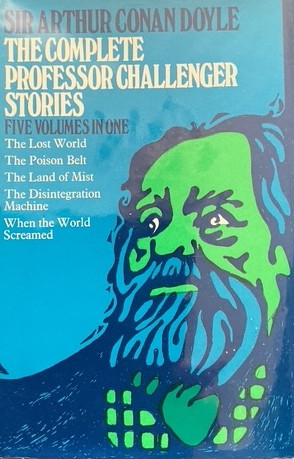
Paperback copies are available and you won’t have to break the bank to get one. The copy I read is in an anthology that contains all five Challenger stories that was published by John Murray in 1963.
Terry Potter
September 2026