Inspiring Older Readers
 posted on 12 Oct 2025
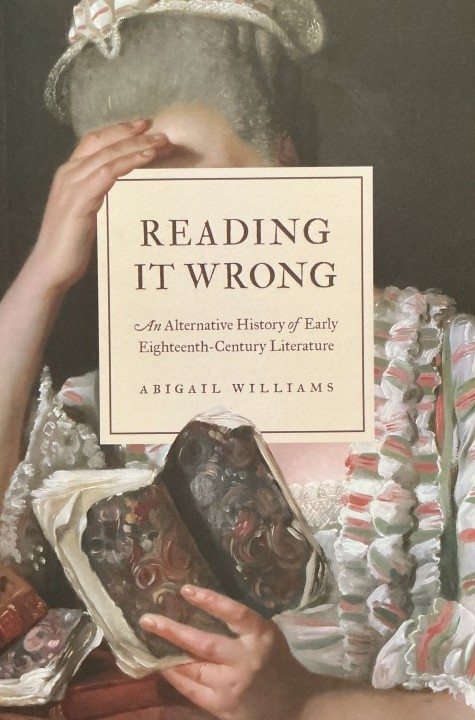
Reading it Wrong: An alternative history of Eighteenth Century literature by Abigail Williams
I’ve written elsewhere on this website about how I first discovered the pleasures of 18th century literature and how thrilled I was to find that the likes of Dryden, Pope and Swift could remain relevant to a 20th century working class boy from Birmingham (you can see some of those other articles here, here and here). So, I was delighted to get the chance to read Reading It Wrong, the new study by Professor Abigail Williams who teaches at the University of Oxford and is a Fellow at St. Peter’s College and promises ‘an alternative history’.
I want to say from the beginning that I found the book a real revelation and that it provided me with some mental liberation. That seems a rather dramatic claim, but let me explain. The starting point for Williams is her own experience of teaching 18th century English literature to students who often found themselves bewildered by the seemingly obscure and often concealed contemporary social and political references in the texts. As a teacher, Williams’ message to her students was that a ‘good reader’ has the task of doing the research that would uncover the true meanings of those aspects of the text that were otherwise hidden. And that is very much the same message I got: if I didn’t understand something, that was my fault and I just wasn’t trying hard enough.
Anyone who has read poetry or prose from that period will know that satire of that time was sprinkled with references to people and places that are ‘disguised’ by the use of dashes, ellipses and deletions that removes letters from the words and leaves the reader to assume who is being talked about. The natural assumption is that this is being done to avoid conflict, legal action and to titillate the reader who would know exactly who was being talked about. The ‘good reader’ will uncover all of this and be in on the joke – just in the same way as the contemporary readers would be.
But Williams now challenges this model of the good reader – suggesting that the contemporary reader probably didn’t know who or what the name was that had been obscured and, more importantly, didn’t expect to. In this sense ‘reading it wrong’ was common, part of the joke and could be considered as a puzzle to be shared by the readers. She uses archive materials, annotations in original copies, readers’ diaries and their letters to establish that our later ideas of what a ‘good reader’ should be is misplaced. Historically, this was a time of rapid expansion in the reading public and the use of obscure Classical references and institutionally specific examples was unlikely to be understood by a growing bunch of readers not educated to that level – for them the puzzle, the not-knowing, was part of the fun.
There’s an excellent chapter that focuses on what is perhaps the greatest of the 18th century satires, Pope’s Dunciad, that illustrates her points perfectly. What I especially liked and very much agreed with is that perfect historical understanding and interpretation is not necessary to enjoy or understand the import of the satires – the spirit of the message and the wider universal truths can be absorbed without stopping to constantly dig out the ‘real’ meaning.
For me this is liberating. For many years I have been slightly guilty about the fact that while I love Pope and Swift I have rarely been assiduous enough to spend a lot of time digging into the history to become a model ‘good reader’. Now, with Williams’ help, I can continue to enjoy The Dunciad without worrying that I’m not working hard enough!
Available now from Princeton University Press, you will be able to get a copy from your local independent bookshop – who will be happy to order it for you if they don’t have it on their shelves.
Terry Potter
October 2025