Inspiring Older Readers
 posted on 21 Oct 2025
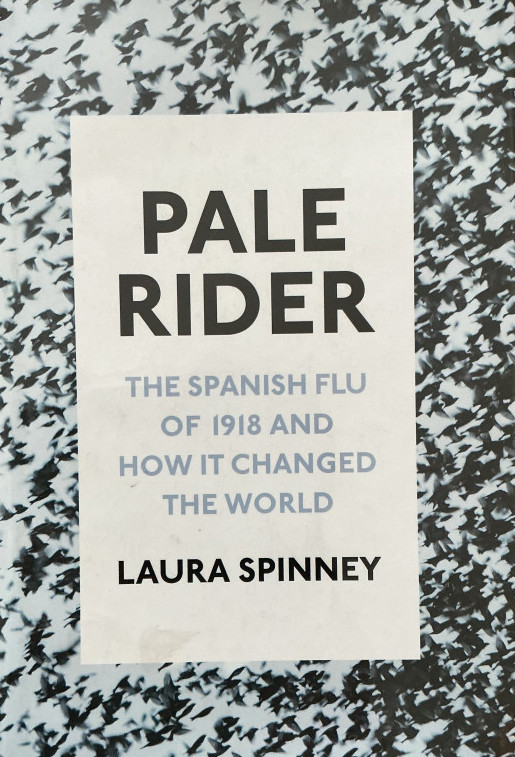
Pale Rider: The Spanish Flu of 1918 and how it changed the world by Laura Spinney
Sometimes a book gets overtaken by history, usually to its detriment, making the contents seem irrelevant or ill-considered. Laura Spinney’s Pale Rider: The Spanish Flu of 1918 and how it changed the world originally published in 2017 will certainly be given a completely different reception in 2025 than it was when it first appeared – but history has not, on this occasion, rendered the book obsolete but cast it in an even sharper and more interesting light. The reason is simple: the onset of the (ongoing) Covid pandemic that took root just two years after Spinney’s book hit the shelves.
The book starts with what for me is one of the most interesting aspects of the 1918 flu pandemic: why was it that in the second half of the 20th century and into the first decades of the 21st, history books and the popular culture memory seem to have completely forgotten that it even happened? We are all very accustomed to thinking of the 20th century as the time of war and lamenting the astonishingly tragic loss of life that happened as a result but how many of us were told by teachers or our text books that the global loss of life from the Spanish Flu pandemic was greater than the two World Wars combined? Spinney puts it this way:
“It was the greatest tidal wave of death since the Black Death, perhaps in the whole of human history.”
And, sadly unsurprisingly, the death toll was, in terms of percentages of population, more devastating in the poorer, less technically developed countries of the world where health services were even more basic than in the richer nations.
But why is it the Spanish Flu? Because it originated in Spain, presumably? Well, no. It seems likely that the origins of the infection may have taken root in the USA amongst those mobilised to go to Europe to fight in the Great War where it was transported into the trenches to run riot and find its way around troops of all nations and inevitably back to their homelands. So why Spanish?
“When the flu arrived in Spain in May, most Spanish people, like most people in general, assumed that it had come from beyond their own borders. In their case, they were right. It had been in America for two months already, and France for a matter of weeks at least.”
But because Spain was neutral in the war, news of the arrival of the flu was not suppressed as it was in the US, France and the other warring nations, leading to the assumption that the infection had first appeared in Spain. Despite the obvious inaccuracy of this story of how the flu travelled, the label of the Spanish Flu stuck.
Spinney is excellent of the history of infection, the likely emergence of flu as a malady and even gives plenty of indication of the perilous links between the passing of viruses between humans and birds. Her overview of the way in which the medical and political establishments responded to the virus as it ripped into their populations will be eerily resonant with a post Covid reader.
But, of course, the author couldn’t time travel and didn’t know that a mere two years later we would be in the grip of another global pandemic that makes much of the final section of her book seem like an unfinished story. She maps the development of vaccination against the ever-changing nature of the flu virus and there’s a sense that we now maybe have the weapons at hand to deal with the threat and prevent such mass carnage again.
What’s missing and is no fault of the author’s, is just how all of this casts light on Covid and how we dealt with it – why, crucially, we failed to learn so many of the lessons openly available in this book.
So, it leaves you to pick up the story and to draw the parallels – which I think is still necessary and worthwhile.
A paperback is available and will cost you a little over £10.
Terry Potter
October 2025