
Inspiring Older Readers
 posted on 05 Nov 2025
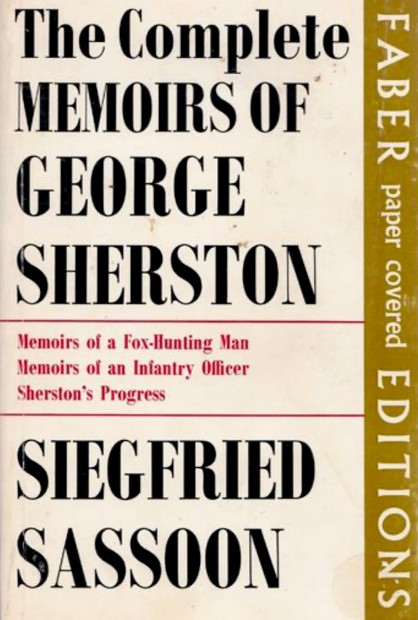
The Complete Memoirs of George Sherston by Siegfried Sassoon
It has already been seven years since I last read The Complete Memoirs of George Sherston, Siegfried Sassoon’s trilogy of the Great War. It was reviewed here, in an article looking at a number of anti-war classics, but so far Letterpress hasn’t covered it in its own right. To do so now seems both timely and necessary.
The trilogy comprises Memoirs of a Fox-Hunting Man (1928), Memoirs of an Infantry Officer (1930), and Sherston’s Progress (1936). The first volume covers Sherston’s rather aimless and self-centred late-teenage years, hunting and cricketing throughout the Weald of Kent, his failed university years, and his entry into the army and early military training.
The middle volume covers his first and second periods in France at the front, including the sniper’s bullet that sees him evacuated to England and hospitalised. It is also very much concerned with Sherston’s intellectual awakening and his growing discontent with what he regards as the fumbling dishonesty of Britain’s conduct of the war and the unthinkable scale of the losses – ‘conscripted populations slaughtering each other’, as he puts it at one point. He is feeling his way uncertainly towards an anti-war position. Easily lost in political or moral argument regarding the war, he recognises that he is not an intellectual but that protesting effectively against the war may mean he has to become one.
The final volume covers his refusal to rejoin his regiment, the anti-war statement he prepares and his desire to see himself court-martialled – a ‘martyrdom’ he believes may help swing public opinion against the continuation of the war. But this is something the War Office refuses to do, instead declaring him shell-shocked and unfit for duty and sending him to Slateford (actually Craiglockhart, the famous military psychiatric hospital), where he meets and is treated by the eminent psychologist W.H.R. Rivers. It gradually becomes evident to Sherston that by shutting him away for the duration of the war the War Office has successfully stripped his refusal to return to the front of any moral purpose and rendered it indistinguishable from shirking. He decides to return to active service, and as quickly as possible.
While The Complete Memoirs of George Sherston is obviously about the Great War, it is also about more than the war. It is also about England and a particular class upbringing and a certain sort of lifestyle – public school educated, of independent means, and part of an upper class country set whose hunting, shooting, fishing, golfing and cricketing lifestyle represents an uninterrupted continuation of values developed during the heyday of Victoria and the British Empire. All of this should make Sherston as emptily entitled and as obnoxious as I think Sassoon intends us to regard him; that it doesn’t, or doesn’t quite, seems to me to be one of the essential achievements of the book.
The other curious thing about the trilogy, I think, is its reticence. Virtually any of the other memoirs and novels of the Great War are far more graphic in their depictions of war and in some respects this has become more the case with the passage of time. Contemporary novels depicting the First World War – such as Sebastian Faulks’ Birdsong, Jennifer Johnston’s How Many Miles to Babylon? and perhaps especially Pat Barker’s Regeneration trilogy (reviewed here) – offer powerful examples of this. But this is not Sassoon’s way. He seems on the one hand to believe that there are some things that cannot be explained to those who weren’t there (and perhaps should not be); and on the other, intent on containing his experiences within the fictional framework he has chosen. Indeed, in one or two places he even reminds himself that he must guard against his ‘neatly contrived little narrative…sprawling out of its frame’. A later passage I think makes plain the kind of thing he is thinking of: ‘a place of horror and desolation which no imagination could have invented…a place where a man of strong spirit might know himself utterly powerless against death and destruction…and yet discovering in himself the invincible resistance of an animal or an insect, and an endurance which he might, in after days, forget or disbelieve’. I think Sassoon’s reticence is far from being just good manners: it is a carefully constructed protection against any inadvertent cheapening of the suffering he has seen. (But as an outlook it also strikes me as being curiously close to Wittgenstein’s justly famous dictum: ‘Whereof one cannot speak, thereof one must be silent.’)
It might be argued, I suppose, that a slightly greater dash of horror might have given Sassoon’s trilogy greater impact. While this may be true, it would also have made of it a completely different book, and I don’t think his objective was simply to depict the horrors of war – he surely regarded these as self-evident, certainly to anyone not blinded by complacency or self-serving jingoism. Rather, I think his aim was to also depict the beauty and humanity that war destroys, and to do this I think he knew that he must somehow craft a book that readers would choose to return to for its pleasures as well as for its admonitory truths. Reading it yet again seems to emphasise how simple and straightforward and apparently artless the trilogy is; but it also reveals the quiet audacity of Sassoon’s overall conception and approach. Even after all these years it retains that enigmatic timeless quality that many apparently simple but great works of art have.
Alun Severn
November 2025
First World War literature elsewhere on Letterpress:
Armistice Runner by Tom Palmer
The Missing of the Somme by Geoff Dyer
The Dust that falls from Dreams by Louis de Bernières
The Old Century & seven more years by Siegfried Sassoon
All Quiet On The Western Front by Erich Maria Remarque