
Inspiring Older Readers
 posted on 09 Nov 2025
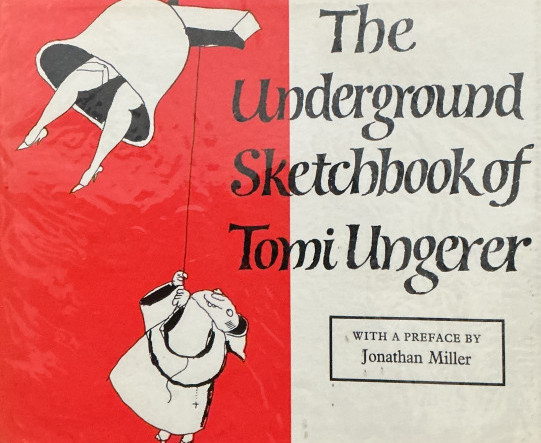
The Underground Sketchbook of Tomi Ungerer
Born in Strasbourg, France in 1931, Tomi Ungerer might well be best known as a prolific and excellent illustrator of children’s books. He is also the recipient of numerous awards and prizes for his illustrations – The Hans Christian Andersen Prize and the Erich Kästner literary award amongst them. His children’s books are frequently reprinted and remain as popular today as they were back in the 60s.
However, Ungerer was much more than just a children’s book artist and the award of the Legion d’Honneur in France and the European Prize for Culture testify to that wider dimension in his work. In fact, Ungerer was an important figure in the cultural underground of the 1960s and his first major solo exhibition in 1962 corresponded with him becoming active in the anti-Vietnam and civil rights movements of that time. Like many graphic artists of the period, Ungerer started producing posters and campaign material for a number of causes and spoke out against the social injustices and inequalities he saw around him. Ungerer’s official website describes his output in these years in this way:
“Renowned for his iconic advertising campaigns and his contentious political posters that railed against the Vietnam War and racial injustice in the 1960s, Ungerer’s frequently subversive work provides invaluable commentary on the divisive socio-political events of the second half of the twentieth century.”
Although he died in 2019 his legacy lives on and there have been both posthumous and reprinted works for children and adults released on a fairly regular basis, as well as the aforementioned website that promoted all things Ungerer.
I’m a big fan of Ungerer’s children’s books because they all have a distinctly quirky view of the world and a wild imagination at their centre but I love his adult collections of drawings even more. His 60s work in particular appeals to me because like the work of Ralph Steadman and Gerald Scarfe – who are broadly speaking contemporaries – and Martin Rowson and Steve Bell in the contemporary arena, he takes no prisoners with his social, political and cultural criticism. Visceral, repulsive and frequently offensively macabre he pins the greedy, the mendacious, the arrogant and the vain.
And this is the spirit that presides over his 1964 collection, The Underground Sketchbook of Tomi Ungerer. I am especially fond of Ungerer’s own words about what he thought he was doing with his socially conscious artwork:
“Satire is the outlet for my revulsion towards a society turned into a pigsty by materialism, consumerism, greed and arrogance.
I have particularly aimed my pen at the bourgeoisie and its hypocrisy. I am a satirist to this day though more so in the medium of writing, collage and sculpture. I have been reproached for being obscene in my depictions, but what can I do, society is obscene and my drawings reflect this. And without mercy!”
As with all good social satirists, Ungerer reveals himself to be a natural heir to Jonathan Swift and he clearly subscribes to the view that humanity is a great disappointment precisely because it could be so much more than it aspires to if only it would lift its nose from the trough. In this collection he pulls no punches and he holds his subjects up to scrutiny and ridicule – all done with a few seemingly effortless pen and ink drawings that feel like deconstructed cartoons. The introduction to this book was written by the late, lamented Jonathan Miller who has this to say about the collection:
“Ungerer illustrates a world where things are coming apart, where the old unquestioned entities are at best provisional arrangements, loosely thrown together and never to be relied upon.”
If you’d like to see more of Ungerer’s adult work you should click on this link:
https://www.tomiungerer.com/drawings
While you’re there, there’s plenty more on the site to browse around.
My copy of The Underground Sketchbook shown here is the 1964 UK first edition and copies of that can be quite expensive but it has been reprinted and is in paperback, so copies can be found for affordable prices.
Terry Potter
November 2025