
Inspiring Older Readers
 posted on 18 Nov 2025
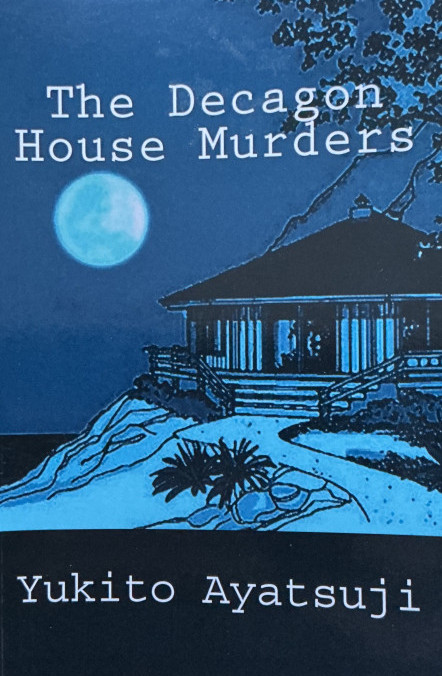
The Decagon House Murders by Yukito Ayatsuji
In some ways the historical importance of this classic Japanese detective/murder story is more absorbing than the mystery contained within the plot itself. During the inter-war years Japanese authors interested in murder mystery thrillers developed a genre of writing that was known as the ‘honkaku’ or ‘orthodox’ mystery format that was heavily influenced by what we now know as the European and US Golden Age novels which abided by a set of golden rules – rules that were more important than notions of social realism. However, in the 1950s a new school of authors (with Matsumoto Seicho at the forefront) came along to challenge this honkaku dominance, emphasizing social realism as their key feature.
Honkaku was eclipsed until the emergence in 1987 of Yukito Ayatsuji’s The Decagon House Murders which reintroduced the rules of The Golden Age but with an added element – an addition that Shimada Soji notes in his introduction to the edition featured here:
“…Ayatsuji also did away with focusing on the latest science…and set the murder and the solving of the case with an isolated house as its stage from start to finish…Thus his novel approached the form of a game more so than anything previously written. As a result, his characters act almost like robots, their thoughts depicted only minimally through repetitive phrases. The narration shows no interest in sophisticated writing or a sense of art and is focused solely on telling the story. To readers who were used to American and British detective fiction, The Decagon House Murders was a shock. It was as if they were looking at the raw building plans of a novel.”
This is a style – called ‘Symbolic Characterisation’ – that belongs as much to the world of video gaming, anime, as much as to novel writing. There’s a distance and abstractness that takes a little time to adjust to but which ultimately makes entire sense.
So much for theory but what about the plot? Clearly there’s a limit to how much of this I can reveal without completely spoiling the storyline – it is, after all, all about story telling. So, I’m going to fall back on the plot synopsis provided by the book jacket:
“Students from a university mystery club decide to visit an island which was the site of a grisly murder the year before. Predictably, they get picked off one by one by an unseen murderer. Is there a madman on the loose? What connection is there to the earlier murders? The answer is a bombshell revelation which few readers will see coming.”
Other reviewers and critics have drawn the obvious parallel with Agatha Christie’s ‘And Then There Were None’ and the fact that the students all adopt pseudonyms culled from Western writers of Golden Age Crime – Ellery, Agatha, Leroux, Carr, Van Dine, Poe and Orczy – simply underlines the fact that the novel is an exercise in form.
I suspect readers will find themselves put on the back foot by The Decagon House Murders and will find themselves slightly worried by the lack of any real characterisation and by the almost mechanical working of the plot. That was true for me too until about half way through when I twigged what the author was trying to do and, after that, I was more than happy to go along with it.
The book is available in paperback for well under £10
Terry Potter
November 2025