
Inspiring Older Readers
 posted on 23 Nov 2025
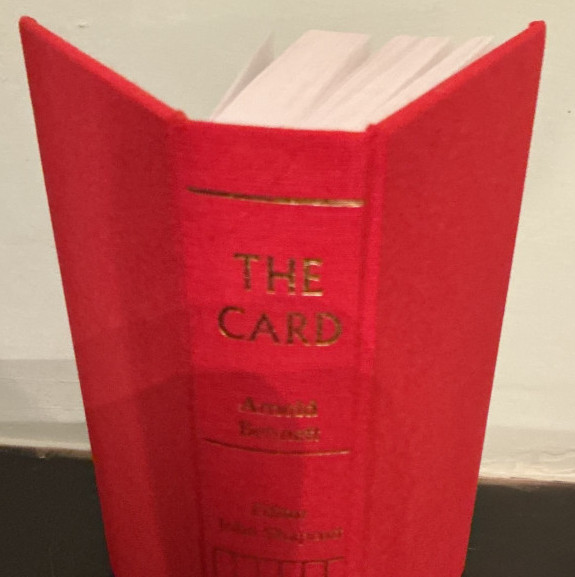
The Card by Arnold Bennett
Almost universally described as a ‘comic’ novel, Arnold Bennett’s The Card, chronicling the rise and rise of Edward Henry Machin was published in 1911, just one year after H.G. Wells gave us The History of Mr Polly – and there’s much the two have in common. As well as having what I think of as a very Edwardian sense of humour, both novels take their working-class hero and throw them out into a wider world in which by hook or by crook they flourish.
In Bennett’s case Edward Henry Machin – nicknamed ‘Denry’ by his mother and known universally by everyone subsequently by that moniker – rises socially and financially by virtue of opportunism, quick wits, an eye for the main chance and a sort of commercial intelligence that can’t be taught in schools.
His rise begins when, though a piece of opportunism, he gets the chance to artificially enhance a school test score to win a scholarship to grammar school – quite an achievement for the son of a lone parent in The Potteries living off sewing and laundry jobs. When he leaves school he gets a job working for the town clerk and once again an opportunity arises for his to bluff his way to a major social event and to put others in his debt by getting them invites they otherwise would have no chance of receiving.
He uses opportunity after opportunity to hop up the social ladder and soon the young boy who was seemingly destined to a sort of gauche anonymity is the talk of the town – a real card.
Again, cashing in on an opportunity he leaves his job to set up as a freelance rent collector and he’s soon thinking of ways to enhance his incomes still further. For Denry, every circumstance is an opportunity, a chance for enhancement socially or economically – and even romantically when he finds himself in a relationship with his dancing instructor, Ruth Earp. When the two go on holiday to the seaside, accompanied by Nellie, Ruth’s friend and chaperone, Denry starts to discover that Ruth is in fact a bottomless money-pit and decides that he doesn’t need that entanglement while at the same time discovering another money-making wheeze to do with a lifeboat (find out for yourself!).
Without re-running the whole plot, suffice it to say that Denry will keep innovating and finding new commercial opportunities, decide Nellie is the girl for him and even end up as his home-town’s Mayor. And all this will be achieved without losing the admiration of all around him who are quick to acknowledge that he’s a fine card.
Tellingly, I think, Bennett ends the story thus:
“What a card!” said one, laughing joyously. “He’s a rare ‘un, no mistake.”
“Of course, this’ll make him more popular than ever,” said another. “We’ve never had a man to touch him for that.”
“And yet,” demanded Councillor Barlow, “what’s he done? Has he ever done a day’s work in his life? What great cause is he identified with?”
“He’s identified,” said the speaker, “with the great cause of cheering us all up.”
And I think that this is what takes us a little beyond it just being a brilliantly written light comic novel. I think the date of publication tells us something important here – this is Bennett identifying the dawning of a new kind of entrepreneur, someone who prospers on their wits not by their labour, class status or real inventiveness. Denry has, as is noted, done nothing but be in the right place at the right time and be unremittingly astute and humane when necessary. This is the start of the rise of a new kind of economics – the chancer who can see the gap in the market and can get others to fill it.
So unlike Wells’ Polly who is at his happiest when he’s out of the rat race, Denry is busy redefining what the rat race will become as 20th century capitalism matures. The message comes in such an affable package you’d be forgiven for passing the book over as just a well-written light-entertainment but, in my view, there’s real substance here and it’s well worth exploring if you haven’t already.
Easily available in paperback at very affordable prices in a range of editions, don’t expect to pay more than a few pounds for a copy.
Terry Potter
November 2025