
Inspiring Older Readers
 posted on 02 Dec 2025
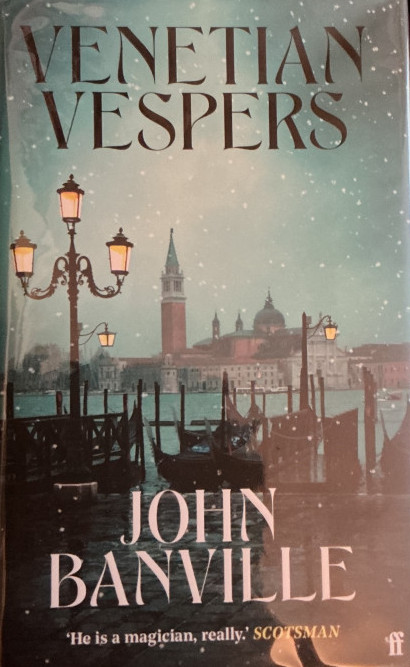
Venetian Vespers by John Banville
The novels of John Banville are usually guaranteed to be examples of his beautiful writing skills in which small details and impeccable atmospheric construction do justice to one of Banville’s literary icons, Henry James. His books are never quite as enormously convoluted as James’ but they are comparatively slow reads that need to be savoured. But Banville also has another identity as a writer, Benjamin Black, under which pseudonym he writes fast-paced, intelligent, intricately structured detective mysteries. In this guise, Banville takes his foot off the brake and just has lots of fun.
Imagine then what might happen if the more seriously intent Banville teamed up with the more rampant Black to produce a hybrid entertainment – well, now we know what it would be like and it’s called Venetian Vespers.
Set in the last year of Victoria’s reign, the bumptious Evelyn Dolman, who is the narrator of this tale, earns his living as a jobbing, hack author who has (rather unaccountably) just married an American, Laura Rensselaer who appears to be the heir to a gigantic fortune. Access to this fortune seems to be closer to hand than expected when Laura’s father dies unexpectedly in a riding accident and we join the story as the newly married pair head to Venice for their belated honeymoon – very much at the insistence of the ‘grieving’ bride.
Even at this early stage, Banville is busy giving us plenty of reasons to expect the worst for Dolman. We know there’s ruination coming for the young man; we know Laura is hiding plenty (she has in fact been disinherited for some reason that will only become clear later); we know Laura’s sister is cold and distant towards Dolman; and, we know Laura’s choice of Dolman as a husband must have an ulterior motive. And then there’s Venice.
In this book Venice is not just a setting, it’s a malevolent character constantly there and constantly malign. The action of the book takes place over just a few days but in the claustrophobic, misty, cold winter of Venice it feels as if Dolman’s suffering is eternal. And so this book joins the pantheon of other notable novels in which Venice appears as a palpable entity, a location of unease: think Thomas Mann’s Death in Venice, Daphne Du Maurier’s Don’t Look Now, Ian McEwan’s The Comfort of Strangers.
While we know that Dolman is being used and cruelly manipulated by a cast of characters that wouldn’t be out of place in a Gothic novel, we struggle to feel he’s a tragic figure. Even at his nadir, he remains an absurdly pompous. The plot requires a death but even that feels secondary to the mechanical working of the inevitable outcome that’s being conducted – an outcome that feels coded into the Venetian environment. Marcel Theroux, reviewing this book for The Guardian, makes this very perceptive assessment of our narrator:
“Evelyn is not only tricky, he has an orotund prose style. Not for him the simple declarative sentence; he likes a hypotactic Jamesian pile-up of adjectives and adverbs, with careful qualifications and a sprinkling of abstract nouns. To an extent, I get that Evelyn’s style is his character: splenetic, self-regarding, full of complaint. His monologue, packed with repetition and the formulations of a hack writer, is also a disguise that conceals him from us and from himself. It’s clear also that we’re not meant to like him.”
You’ll have spotted by now that I’ve said very little about the mystery itself and that is, of course, deliberate. Although it’s intricately plotted and you wouldn’t want any spoilers from me, it’s also one of those novels where we seem to be more aware of what’s happening than the narrator.
In truth, this book is all about atmosphere and uneasiness – something Banville delivers in spades. But I suspect there will be some, like me, who feel that readable as this is, escaping from the almost cloying, overwrought story comes as something of a relief. Even the richest of perfumes can become too much in a closed room.
Currently available in hardback, the paperback will no doubt be along shortly.
Terry Potter
December 2025