
Inspiring Older Readers
 posted on 07 Dec 2025
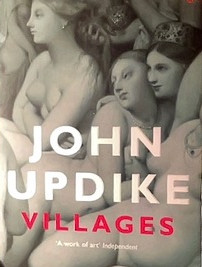
Villages by John Updike
Aside from the Rabbit Angstrom quartet (the first volume is reviewed here), I have always felt that Updike’s real claim to literary greatness lies in his short stories. Or, put another way, there are two reasons why I prefer the short stories: first, they are an intense distillation of Updike’s best writing; and second, there is less sex in them. I’ll come back to that.
Anyway, it has been too long since I last read any of Updike’s full-length fiction and so recently I returned to his 2005 novel (his twenty-first, by the way), Villages.
In this novel he tried something new, making his central character, his Updikean doppelgänger, a scientist of sorts – a seventy-year old retired software engineer and tech entrepreneur, Owen Mackenzie. A maths and computer science graduate from MIT, Owen goes on to work in a lowly capacity for IBM, until in the late-60s he and another disaffected IBM minion, Ed Mervine, quit their oppressive but secure corporate cubicles to launch a tech services start-up. Ed is the quintessential computer nerd, but he is also savvy and worldly and early on he sees that companies across the country will need ‘contract coding and advisory services’ if they are ever to get the giant mainframe computers they are investing in to do anything useful. ‘[T]here’s a world out there of medium-sized companies that have paid a couple hundred thousand for hardware they don’t know how to operate,’ he explains to Owen. ‘…Manufacturers, distributors, these new franchises, lesser airlines, banks, architectural firms. IBM and Sperry Rand can’t be bothered with them; they farm them out, to assholes.’ And that’s where Ed and Owen come in: they can be ‘better assholes’. They just need to find somewhere with low overheads and plenty of cheap ex-industrial space or old mill buildings for rent.
What we learn of Owen’s life unfolds along with his marriages (three), the changing political, economic and moral climate of the passing decades, the lightly but brilliantly drawn early history of computers, and the increasingly suburban and middle class villages of the title in which he lives – Willow, in rural Pennsylvania, his birthplace; Haskells Crossing, Massachusetts, his middle-period; and Middle Falls, Connecticut, his retirement.
As with other Updike novels, this canvas of the public and private, the social and the erotic, the interior and the exterior life, is for the most part handled with immense fluency and the kind of sure-footedness and skill that comes from a lifetime’s practice. But there is a problem. Updike has done this before, and arguably to better effect and with greater relevancy. For Villages to some extent retreads the ground and the zeitgeist-y themes he tackled in earlier and more timely novels, such as the notorious Couples.
Consequently, Villages seems to exemplify both Updike’s virtues and vices. His prose at its best is breathtaking – supple, subtle, graceful, crammed with insight and interest and beauty, whether writing of human relationships, ageing, loss, or the tides of economic, social, scientific and cultural change that thrust some places and communities and occupations into the ascendancy while sweeping others aside. That he can do this in Villages while also nimbly sketching in the computing background is nothing short of extraordinary. But his obsession with sex and adultery – once cutting-edge subjects, perhaps, as the Sixties swung and the Seventies faltered – now seems not just dated but unpleasant: the absurd self-indulgence of a wealthy suburban bourgeoisie.
Updike is often referred to as a poet of sex, but I think this is the aspect of his fiction that has worn least well and I now value him far more for the poetry he finds everywhere else – in mundane landscapes of malls and low-rise outlet stores, country back lanes, winter trees, the light falling across clipped suburban lawns; but especially the hidden lyricism he finds in work, whether the world of tech service start-ups or the satisfaction (almost erotic!) Harry Angstrom finds in his successful Toyota dealership in the Rabbit books.
In fact, perhaps Updike is really the poet of entrepreneurship and the American Dream? Whatever the case, I think it is this rather than his elaborately explicit writing about sex that is his most enduring legacy.
Alun Severn
December 2025
Updike elsewhere on Letterpress:
The Witches of Eastwick by John Updike