
Inspiring Older Readers
 posted on 11 Dec 2025
How the Peregrine came into my life
“Impostor syndrome, also known as impostor phenomenon or impostorism, is a psychological experience in which a person suffers from feelings of intellectual and/or professional fraudulence…. Those who suffer from impostor syndrome often doubt their skills, talents, or accomplishments. They may have a persistent internalized fear of being exposed as frauds.” (Wikipedia 2025)
Imposter syndrome: although I wasn’t familiar with this term back in the early 1970s, it’s most certainly something I was feeling as I contemplated leaving my job in a Birmingham bookshop to take up the offer of a chance to do a degree in English Literature. For a mix of complicated reasons that are too tedious to itemise here, I’d left school at 16, gone onto an FE college for a year, left there and fluked a job at (the then prestigious) Hudson’s Bookshops and taken up night classes to complete some A levels. I absolutely loved the job and I was very tempted to stay there – it might seem astonishing now but at the time there was quite a decent training scheme for the trainee bookseller and there seemed to be a semblance of a career structure. But… the pay was pitiful and would remain that way for the foreseeable future.
So, should I stay or should I try the university path? I’d done unexpectedly well in my A levels and I had offers from several English departments to study what was rapidly becoming my overwhelming intellectual interest – the study of literature. But the decision wasn’t at all an easy one: a working class boy who had very little experience, had never travelled much outside of his home town, came from a family that had no experience of further education (with the exception of an older brother who had also gone down the night school route) – I was greener than green.
Perhaps rather uncharacteristically, I decided to take a chance and make the break from home – maybe it was a temporary rush of blood but I chose my university, told my employer, told my parents and then had several months in front of me to contemplate what I’d done.
And what started to emerge as my dominant feeling? Enter imposter syndrome. What on earth was I doing? I would clearly be out of my depth amongst all of the confident, big brains who would just sneer at me and my threadbare knowledge and gauche working-class habits. I needed some defences: I needed something to mask my hopelessness. I turned to accumulating books that would be bound to impress.
Looking back, it’s a logical enough response given that I still had plenty of time left to work in the bookshop and the staff discount on stock was insanely generous at that time. I took full advantage.
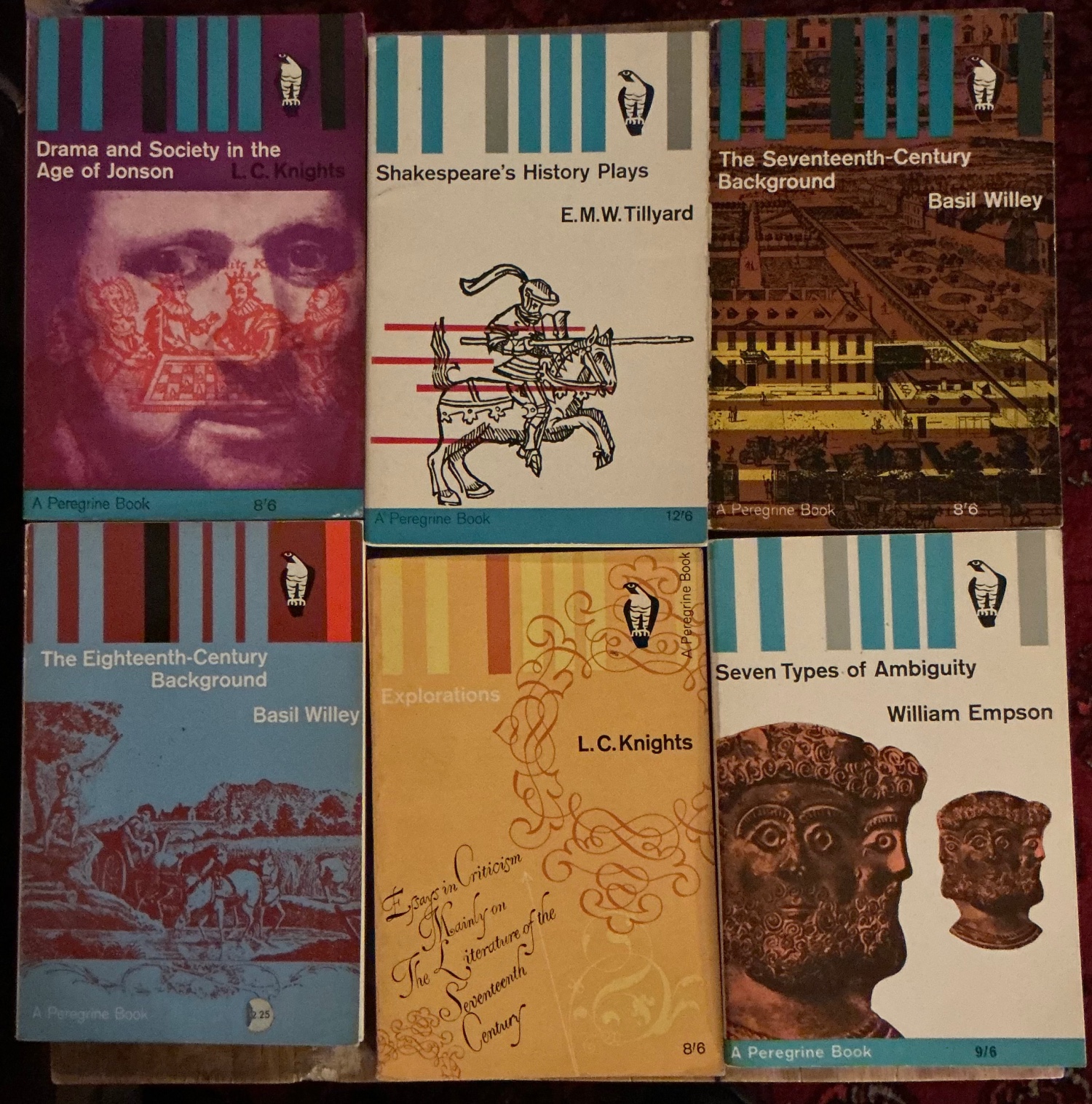
And this is where Peregrine books came into my life and became an enduring love of mine. Peregrine was an imprint within the Penguin book empire and was established in 1962 with the aim of being indispensable to the academic market – especially students. The paper they were printed on was noticeably of a higher grade than the usual paperback, they had sown spines which meant they didn’t crack and fall apart as the glue dried out and the list of titles was, at the time, from the front line of literary, historical and philosophical endeavour. I also loved their size – a little bigger than the average paperback (7.75 inches x 5.5 inches) and although more expensive than other Penguins, so much more lovely as artifacts.
The series ran until 1975 and included 100 titles and I found myself trying hard to get as many of the English literature titles as possible – most of which I still possess today as you will see from the photograph at the top of this article.
The excellent Penguin First Editions website page which focuses on and lists the titles of the Peregrine books tells us:
“The early emphasis was on history and English literature. The earlier books carried the motif of a perched falcon, looking towards its right, with a white spine and the ‘Y’ series number at the bottom. After about 10 years there was a brief lull in titles, with a fresh looking cover design and more of a focus on sociological material, often with a left-wing bias.”
It felt as if these books were designed especially for me and for that moment in which I most needed them. They went off with me to university, a buttress against my own inadequacy, and they served me well. They not only gave me an vicarious sense of academic credibility, they gave me a love for literary criticism that has held me in good stead over subsequent years.
I buy Peregrine titles I don’t have when I see them in decent condition but I don’t go on dedicated searches for them. I dare say that it would be easy enough to buy the whole set if I systematically trawled the internet – but where’s the fun in that? No, I wait until I see the bird perched on a shelf just waiting for me to find and bring it home and to take its place alongside the others that make up a remarkable library of thought.
In their way, they saved me and now, in my way, I save them.
Terry Potter
December 2025