
Inspiring Older Readers
 posted on 21 Dec 2025
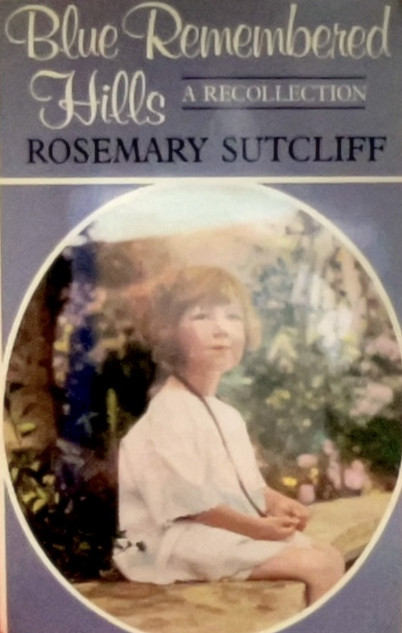
Blue Remembered Hills by Rosemary Sutcliff
Rosemary Sutcliff is best known for her historical fiction for younger readers, especially her Roman Britain trilogy comprising The Eagle of the Ninth (reviewed here), The Silver Branch, and The Lantern Bearers. In fact, I have never read a word of her fiction – an omission I ought to put right – but somewhere along the way, and for reasons I now can’t recall, I became aware of her memoir, Blue Remembered Hills, published in 1983, and recently, stuck for something to read, I spotted my rather dog-eared paperback and decided it was time to read it again. I’m so glad it occurred to me to do so.
The bare facts of Sutcliff’s life can be told very briefly. Born in 1920 to what I suppose one might call a middle class professional and colonial family, her father was a naval officer, serving sometimes overseas (Malta, South Africa), sometimes at the Admiralty, and sometimes as the King’s Harbour Master at the Royal dockyards of Sheerness or Chatham. Sutcliff suffered from a rare form of childhood arthritis called Still’s Disease and so as well as being a peripatetic navy family, leaving friends and familiar places behind as they moved with each fresh posting her father received, she was also an only child who for much of her childhood was unable to walk, spending long periods not just without friends but sometimes without the company of any other children. Her loneliness and inwardness and self-sufficiency all played a key part in shaping the writer she would become.
The memoir only covers her childhood but does extend to her young adulthood, ending with the acceptance of her first novel in 1950. I usually have a fairly low tolerance for childhood memoirs but Rosemary Sutcliff’s recollections of her childhood are distinguished by the quality of her prose and the vividness, freshness and most especially the honesty of what she describes. That her honesty is scrupulous and unflinching – whether of herself or others – is also important, for she manages this while also remaining tender and considerate towards those she loves.
She conveys the illness of her childhood years and its consequences with humour, a sort of detached interest and an entire absence of self-pity or self-dramatising, and focuses primarily on the places, people, experiences and books that she believes made her a writer.It is a short book and deceptively light in the reading – but it is carefully wrought and has a meticulously judged emotional temperature. And what makes it especially interesting to contemporary readers is that the childhood it describes now seems so impossibly remote, the vanished world of the 1920s appearing before us, softly lit, almost like lantern slides.
But to give a proper sense of the book I have to convey Sutcliff’s particular tone. Here she is writing about the period when she was about five and the family was living together for a change in service quarters at Sheerness – a beautiful Georgian house designed by Robert Adam, with the mist-shrouded marshes near-by. Every six weeks or so the family had to go to London for her to have medical treatment. ‘I think the arthritis, known as Still’s Disease, must have burned itself out by the time we left Malta,’ she writes, ‘because I have no recollection of being ill in Sheerness, only of having various unsatisfactory joints, and not being able to walk, and going up to London every six weeks to visit a surgeon called Mr Openshaw. Mr Openshaw, as his name suggests, was a North Countryman, a short tubby man with hands like a butcher’s. It is disappointing how few surgeons have the kind of hands one would expect; lean and strong, with waisting between the joints and spatulate fingertips.’ The fluent, casual accuracy of that passing observation is a delight.
She goes on: ‘He belonged to a school which I suppose is now extinct in this age of technical improvement, and I remember him cutting off a plaster-cast of mine with a thing like a jack-knife. He began at the top, almost at the hip, and ended at the toes, in one steady, unceasing cut. I saw with interest his wrist quivering with the force he used. I felt the cold tip of the knife touching me the whole way, but when the cast was broken open and forced off, there was not a scratch, not the faintest mark on my skin.’ I quote these passages at length because they are characteristic of Sutcliff’s cool, detached tone and vivid observation.
Some have said that Rosemary’s mother is treated harshly but I don’t think this is entirely the case. The responsibility of caring for a disabled child must have been considerable and Sutcliff acknowledges this and the self-sacrifice it entailed for her mother, but she also says with flinty honesty: ‘She was wonderful, no mother could have been more wonderful. But ever after, she demanded that I should not forget it, nor cease to be grateful, nor hold an opinion different from her own, nor even, as I grew older, feel the need for any companionship but hers. If this seems a terrible thing to write,’ she concludes, ‘I can argue only that it is the truth, and if I left it comfortably unwritten, I could not give a true picture of our relationship, which was a very close one, almost as close at times as she thought it was, and as she would have liked it to be.’
I hope I have given an adequate flavour of this lovely book because its pleasures, I think, lie in the quality of the writing, its cool, beautifully judged emotional tone, and its dignity and intelligence. Secondhand copies of the version pictured are cheap and readily available online; a more recent paperback from the Handheld Press still seems to be about but the publisher ceased trading earlier this year; Slightly Foxed publishes a nicely produced hardback edition. In whatever form you find it, it is a remarkable little memoir by a remarkable woman, best read slowly and savoured.
Alun Severn
December 2025