
Inspiring Older Readers
 posted on 03 Feb 2026
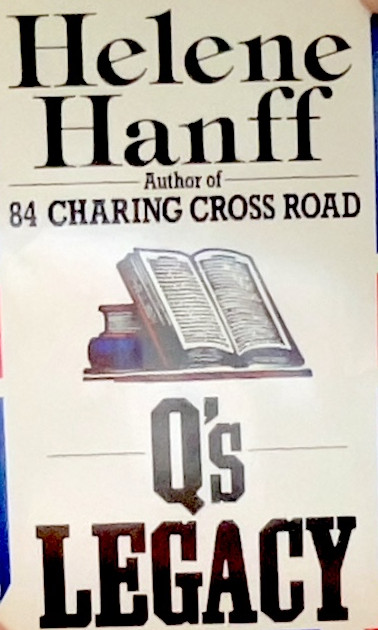
Q’s Legacy by Helene Hanff
I have had a very curious experience over the past few days: a long but unexpected conversation with a dear but rather enigmatic old friend whose slight shyness and dignity and familiar warm tone I treasure, her voice husky I imagine from its generous seasoning of cigarettes and the occasional ‘extravagant martini’. I have never met her in person, of course, but I feel about her as thousands of her readers do. I’m talking about Helene Hanff, the US memoirist, script writer and children’s historian, most famous for her beautiful memoir 84, Charing Cross Road.
Over the past couple of days I have been reading Helene Hanff’s Q’s Legacy, having stumbled on a copy in a charity shop when I was visiting family at Christmas. It was published in 1985 but I had never seen a copy before, let alone read it. It was genuinely a discovery: a book I had thought would be slight, perhaps even disposable – she did after all write a rather forgettable guide to New York called Apple of My Eye, which even she was dismissive of – turned out to be amongst her best work.
Its premise – unlikely as it may sound – is that it is a sort of thank-you, perhaps even a love letter of sorts, to Sir Arthur Quiller-Couch, the eminent Victorian and Edwardian anthologist, editor, literary critic and Man-of-Letters, who also published over thirty adventure novels and short story collections under the pen-name ‘Q’ – which, incidentally, is how his students knew him during the many years he spent as King Edward VII Professor of English Literature at Cambridge University.
One summer, during the Depression, Hanff found herself unable to continue her university education – partly because, as she herself says, she wasn’t smart enough to secure the necessary scholarship, and partly because her family was struggling financially. By way of compensation, she had been enrolled in an ‘office skills’ class being offered by an uncle who had lost all his savings in the stock market Crash and was trying something new to keep the wolf from the door. But Hanff was still desperate to immerse herself in literature and learn how to write – the only thing she really wanted to do – and in the Philadelphia Public Library she stumbled across On the Art of Reading, the first volume of Quiller-Couch’s Cambridge Lectures. Having dismissed other eminent critics and literary scholars whom she found she couldn’t understand, Q’s erudition and plain-speaking and his passionate advocacy of clear writing and careful reading turned out to be exactly what she had been searching for and in the years that followed were to serve as education, guidance and often company too – a voice she came to cherish.
Q’s legacy, then, is the life that Helene Hanff’s sometimes precarious writing career helped her to make – and that is what this book is about. It is the book in which she elaborates on some of the autobiographical background missing in her other works, and as such, far from being the rather dry subject the title might suggest, it is in some ways her most revealing book.
A good proportion of the book covers the years of acclaim following the publication of 84, Charing Cross Road first in the US and then here, its subsequent adaptation for BBC television, then for the big screen, then the first West End play – a huge hit – and its eventual transfer to a Broadway production, disastrous, as it turned out, which flopped and closed within three months.
And Helene Hanff was there for all of these occasions – meeting fans, renewing friendships with the extended Marks & Co family, sometimes reluctantly and at the insistence of her publishers, and sometimes exhausted, but conscious always of the unbelievable good fortune that had transformed her life. They were, she says, the most extraordinary years of her life.
But the Broadway play on her doorstep in New York was a step too far. What had charmed and moved and exhausted her in equal measure in London – the hotels, the publicity interviews, the parties, the bouquets, the acclaim – was a glorious escapade precisely because it could all be left behind in England. But, she says, to have continued to live ‘like a celebrity’ in one’s own neighbourhood – and you can almost hear the distaste – would have been intolerable. The premature closure of the play after barely three months was a blessed relief.
There is a scene late in the book where she describes one bleak Manhattan midnight when, depressed and unable to settle to reading, she is considering the preceding years. She looks at the salvaged shop-sign that had hung over the doors of Marks & Co; US well-wishers had rescued it when the shop was demolished and had had it crated-up and transported to the US and installed on the wall of her apartment. She looks at the bookcase holding the many books – now dusty and tattered, some of them ragged with use – that she had bought from Marks & Co and the booksellers whom she had come to regard as family. ‘I was shaken by what I suddenly knew,’ she writes: ‘If I live to be very old, all my memories of the glory days will grow vague and confused, till I won’t be certain any of it really happened. But the books will be there, on my shelves and in my head – the one enduring reality I can be certain of till the day I die. Of all the gifts in Q’s legacy [they] still mattered most and would matter longest.’
It is hard not to feel that Q’s Legacy completes the story and perhaps tells us as much about Helene Hanff’s life as she wished us to know. Its pleasures are too many to enumerate here but I would single out her account of the opening of the West End play of 84, Charing Cross Road in November 1981, when she realises that some in the London audience are in tears because the post-war dereliction being depicted on-stage as ‘atmosphere’ is what they lived through and for them the play has become testament to a different and more tragic sense of loss. If you can read it without your own eyes filling with tears, then you are made of sterner stuff than me.
Q’s Legacy is funny, warm-hearted and at times deeply moving. It is Helene Hanff’s thank-you letter to Sir Arthur Quiller-Couch – but it is also her final goodbye to 84, Charing Cross Road, a last memorial to ‘Marks & Co. and Frank Doel and all their vanished kind’. It is currently out-of-print but there have been a number of hardback and paperback editions over the years and there seem to be a variety of secondhand copies about at sensible prices. You don’t need to pay the inflated prices being charged by online ‘vintage’ sellers for whom old books are merely another opportunity for profiteering. I think we can all guess what Ms Hanff might have had to say about them.
Alun Severn
February 2026
Helene Hanff elsewhere on Letterpress:
Letter from New York by Helene Hanff