
Inspiring Older Readers
 posted on 17 Feb 2026
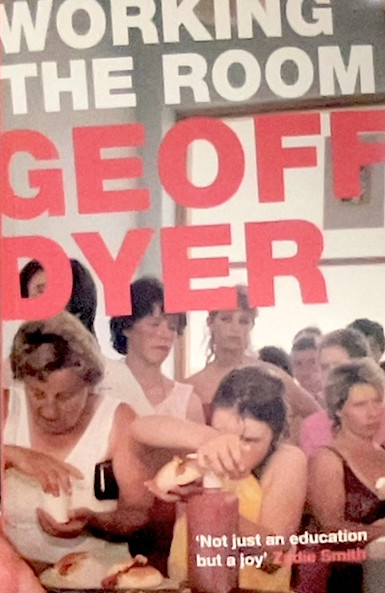
Working the Room by Geoff Dyer
Working the Room: Essays & Reviews 1999-2010 is Geoff Dyer’s second collection of journalism, published in 2010. Somehow I never got round to buying it when it first came out, but his earlier collection, Anglo-English Attitudes, published in 1999, was the first thing of Dyer’s that I read and I remember how impressed I was at the time – how reading him was like discovering a smart new voice but one that was somehow already familiar and for a period I couldn’t get enough of his writing.
Beginning in the mid-80s (his first book – since dismissed by Dyer as ‘timid, sub-academic’ – was a study of the critic, artist and theorist John Berger) Dyer has carved out an enviable writing career, writing it seems on virtually any subject that interests him – and, according to his own account, only on subjects that interest him. He has invented a sui generis literary form in which his struggles to write (or his determination to avoid writing) are as much a part of the text as the subject he should be writing about.
Initially I think I found Dyer fascinating partly because I couldn’t work out how he did it – how he turned hesitancy, incompetence, laziness and a seemingly constant, rancorous inner argument with himself into satisfying, vividly written and erudite prose on subjects as disparate as photojournalism, painting, film, sculpture, jazz, American and European literature, urban life, drugs, travel – you name it. It was evident that some kind of sleight of hand was being practised but I couldn’t work out what it was.
The secret I think is that Dyer is an accomplished mimic whose highly individual prose style and method of working are profoundly informed by writers he idolises. At one time I even wondered whether he might suffer from echopraxia, an involuntary echoing of the words and attitudes and literary gestures of his favourite writers, but of course there is nothing involuntary about it: what Dyer does is deliberate, highly structured and carefully planned; it is just meant to look as if it isn’t.
For a long time I think his primary influences were the novelists W.G. Sebald and Thomas Bernhard, two of the high priests of European Modernism: Sebald for his long, looping sentences, somehow simultaneously archaic and modernist, his mysterious ability to write about multiple subjects while apparently really writing about another entirely – the inexhaustible horror of the Holocaust – and his enigmatic narratives of deep memory; and Bernhard for his obsessively structured and corrosively repetitive novels that turn embittered complaint and egotistical ranting into art high art forms while also being darkly, vituperatively funny. (It obviously helps Dyer’s purpose that relatively few people read these writers.)
I think that for a long time these two main influences fuelled Dyer’s work – his polyphonic arguments with himself – but at some point an additional voice became evident resulting in a more aphoristic style built on layers of paradox. For example, in one piece in this new collection he explains that while some of his friends strove to become writers because of vaulting ambition or unstoppable talent, his main aim was to skive and writing seemed to offer the greatest opportunity to do this. After all, time – his time – he explains, is far too valuable to be given to a boring, pedestrian job and he would rather waste it than have it taken from him by an employer. But in fact, he goes on, despite having almost limitless time in which to do nothing, he still doesn’t have enough time to write, read and do as much nothing as he would like to… I think this additional voice may have been ‘caught’ from Fernando Pessoa, the Portuguese poet-philosopher-provocateur who wrote as seventy or more distinct literary personalities (what he called heteronyms) and died in 1935 aged just forty-seven of cirrhosis of the liver.
In this present collection I thought this dialogue of paradoxes was most evident in an essay called Reader’s Block in which Pessoa is specifically referenced. ‘The phenomenon of writer’s block is well known, but what I am suffering from is reader’s block,’ Dyer says. Sometimes, he explains, he is simply too lazy to read; at other times he feels too guilty to read because reading isn’t work (writing); and at yet other times he can settle down to read only when he doesn’t have time to do so – when he has to rush to catch a train, for instance, or is already on a train but feels that instead of reading he should be paying attention to the exquisite scenery or historic locations passing by outside – only to find that he ‘is like Pessoa in The Book of Disquiet, “torn, in a futile anguished fashion, between my disinterest in the landscape and my disinterest in the book which could conceivably distract me.”’
But I’m still left wondering whether I have given an adequate flavour of what Geoff Dyer is actually like. Critics call him genre-bending or genre-less or beyond genre and there’s some truth in all of these descriptions, but what they don’t explain is precisely what materials he builds his books from and this is what I have been trying – perhaps not successfully – to explain. All I can suggest is that if this has piqued your interest, you give him a try. The collections of journalism give a good representation of his interests but like all such collections can be fragmentary and prone to repetition – not necessarily the best place to start, but good for dipping into for an hour or so at a time. His novels (which include The Colour of Memory, Paris Trance, Jeff in Venice, and Death in Varanasi) I know nothing about because I have always avoided them in the perhaps mistaken belief that they probably repeat what has already been done better in his non-fiction. For it is in his full-length non-fiction, I think, that Dyer really shines; this is where he has the elbow-room to stretch out and write at full throttle.
For a funny, well-written and reasonably straightforward example try Another Great Day at Sea: Life Aboard the USS George H.W. Bush (2014). For a genuinely genre-busting (and sometimes infuriatingly self-indulgent) experiment try his book about failing to write a book about D. H. Lawrence, In Sheer Rage. His book about jazz, But Beautiful is extremely enjoyable. He has also just published an autobiography, Homework, which I haven’t read because I fear that from an author whose main subject is almost always to some degree himself it may come as too much of a good thing. However, anyone wanting to know a bit more about Dyer himself and why he does what he does in the way that he does may find the more personal essays in the final section of Working the Room funny, informative and revealing. To what extent they can be taken at face value is another question entirely, mind you.
Alun Severn
February 2026
Geoff Dyer elsewhere on Letterpress:
The Missing of the Somme by Geoff Dyer
Out of Sheer Rage by Geoff Dyer