
Inspiring Older Readers
 posted on 26 Feb 2026
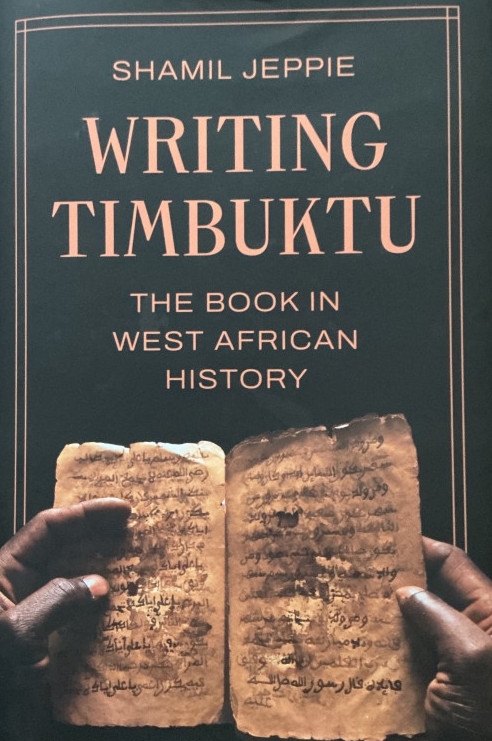
Writing Timbuktu: The book in West African history by Shamil Jeppie
As a young boy growing up in the UK during the Fifties and Sixties, the idea of a place called Timbuktu was both exotic and mysterious. Was this a real place or just a mythical location that had been made up to indicate some far-off, unimaginable land where the rules of ‘normal civilisation’ did not apply? For someone living in inner city Birmingham whether it was a real place or not didn’t really seem to matter too much – I was never going there and I couldn’t easily see why I might ever be interested in what happened there if it really existed.
In the text of his book, Writing Timbuktu, Shamil Jeppie notes that perceptions of Timbuktu in the West were, for decades, dominated by this idea that a city in what we now know as Mali was literally a foreign country – not just in the geographical and physical sense but psychologically and culturally as well. Having read what Jeppie’s research has uncovered, it seems clear to me that the sense of mystery and other-worldliness that hung around that whole region of West Africa has some of its roots in the fact that there were no printed books emanating from that region until the twentieth century.
That last statement still makes me sit up and marvel – not just because there were no printed books but because, as this study demonstrates, there was indeed a book culture but one based on the manuscript, hand-written books. As the jacket inner flap introduction tells us succinctly:
“Printed books did not reach West Africa until the early twentieth century. And yet, between the fifteenth and twentieth centuries, literate and curious readers throughout the region found books to read—books that were written and copied by hand.”
The author makes the point that this is a comparatively short book – no more than 200 pages if you include the notes – but it actually covers a huge amount of territory, enough for a volume two or three times that size. But brevity doesn’t mean it sacrifices ambition or scope. Jeppie tells us:
“This then, is a short book about a large subject: it covers a vast territory and a long historical period. It is an introduction to writing in the Sahara-Sahel with Timbuktu as the focal point, a condensed history from epigraphy to typography with the bulk of the book focused on the impressive manuscript book tradition of northwest Africa.”
The starting point of the story addresses the modern day because there’s no denying that much of the reputation of this area is tied-up with civil war or other border conflicts and Jeppie immediately addresses one of the issues that even I had heard of – the supposed or actual destruction of many of the manuscript libraries of that area and specifically of Timbuktu by tribal armies seeking political dominance in the region. If I understand it correctly however, the custodians of these libraries were astute, ferrying these handwritten books to safety before they could be ransacked and thereby preserving a precious cultural heritage. But the story continues to get richer as we are taken into the history of the creation of these manuscripts. Again, I am indebted to the valuable jacket synopsis which perfectly captures what you can expect to find here:
“After beginning his account in Timbuktu, Jeppie traces the literary connections among places as distant as Marrakesh in the north and Sokoto in the south, and smaller settlements in between. He chronicles the work of Ahmad Baba in late sixteenth-century Timbuktu and his students in early seventeenth-century Marrakesh; the emergence of writers in the eighteenth century in what today is Mauritania; the writings of the scholar-rulers of Sokoto, northern Nigeria, in the nineteenth century; and the eventual discovery of the manuscript-book world of West Africa by European travelers and French colonial officials.”
I’ll be honest and say that I was expecting to discover that the arrival of printing in the twentieth century would have put an end to the manuscript tradition but, remarkably, that is not the case. Jeppie tells us that the manuscript tradition adapted to live alongside a growing print culture and an active oral storytelling tradition and he ends the book with a look at how that worked in practice.
This isn’t a book just for the scholars – although it is indeed scholarly – and it is written in an accessible way for those, like me, who are interested at a lay level about books and the history of books.
Available now from Princeton University Press, you can get a copy from your local independent bookshop – who will, of course, be happy to order a copy if they don’t have it on their shelves.
Terrt Potter
February 2026