
Inspiring Older Readers
 posted on 09 Apr 2026
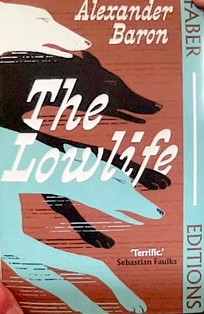
The Lowlife by Alexander Baron
I recently reviewed a title in the Faber Editions series, which is bringing long-neglected novels by ‘radical literary voices’ back into print – works that are notable for their imagination, vision, style, or politics. I found the one I read so interesting that I was eager to try another and moved on to Alexander Baron’s 1963 novel, The Lowlife.
This is a pitch-perfect East End Jewish noir set in a rapidly-changing London of the immediately post-war years, in which for some – such as Baron’s anti-hero, Harryboy Boas, who is Jewish – the Holocaust remains a close-at-hand horror, a source of torment and, in Boas’s case, for reasons I won’t reveal for risk of spoiling the story, guilt.
Harryboy is a professional gambler who spends his life as far as possible avoiding conventional work (unless he needs to rebuild his gambling stake), avoiding marriage and long-term relationships (in favour of brothels), arguing with his respectable sister, Debbie, and her husband, Gus (who is himself a bookmaker but a respectable, non-gambling West End type whom Harryboy despises, despite the frequent but grudging loans Gus makes him), and gossiping with some of the other tenants in the lodging house where he lives – the scrimping, down-at-heel Jewish landlord, Mr Siskin (who lives in the basement); the happy-go-lucky, newly-arrived Caribbean couple, the de Souzas; or his newest neighbours, Evelyn and Vic Deaner and their young son, Gregory, who will come to play a significant role in Harryboy’s life. When he has had a good run of luck and is living on his winnings, Harryboy likes nothing better than to lie on his bed smoking cheroots and reading Zola, then dressing scrupulously in a fresh shirt, a subdued silk tie and a good suit to go out and eat in one of the local Jewish or Italian ‘noshers’ he favours.
I’m aware that that description probably makes Harryboy Boas sound quite despicable and it is an odd paradox of the book that he isn’t and indeed is a curiously attractive figure. In a fine and informative introduction the novelist, essayist and London visionary Iain Sinclair describes Harryboy brilliantly as ‘a self-punishing moralist’ and ‘an elective lowlife’ and I think this is central to the appeal of the character. For if Harryboy didn’t somehow have a hinterland that we sense as being deeper and more complex than his surface life suggests, then we wouldn’t read the novel rooting for him. And I think we do.
Both Alexander Baron and his creation Harryboy are quintessentially Sinclairean figures (Jewish, East End, outsiders) and he writes vividly of a time in the 1970s when The Lowlife was a genuinely lost, underground novel, so thoroughly out-of-print that it might have been erased (like a purged commissar in a Soviet photograph), although a dog-eared copy might occasionally be discovered in ‘Isle of Thanet charity pits’.
Baron was born to Polish-Jewish parents in 1917 and grew up in the East End. Although he broke with the Communist Party over its treachery during the Spanish Civil War, as a teenager and in his twenties he was a committed communist and anti-fascist, helping establish Advance, the paper of the (then communist dominated) Labour League of Youth, editing Challenge, the Young Communist League’s newspaper and battling Mosley’s blackshirts on the streets of Hackney. In the 1940s he became deputy-editor of the leftwing Labour paper, Tribune and was prominent in the Unity Theatre group. Eventually he became a respected novelist and scriptwriter, writing for both Hollywood films and major British TV series right up to the mid-1980s. He died in 1997.
What makes The Lowlife such a fascinating novel despite what some might regard as its squalid setting and unprepossessing characters is the fact that it is much more than it first appears to be, but this seriousness of purpose is hidden in plain sight. First, then, I think it is an existential novel – as much so as Camus, or Sartre, or de Beauvoir or any of the European giants of the genre, but lightly and briskly, and without the weight of self-importance (in this regard it put me in mind of Simenon’s ‘tough’ psychological novels, his ‘romans durs’). Next, although I know nothing of the dog-track or race course, I think its depiction of compulsive gambling is essentially philosophical in that Baron’s gamblers exist in a paradoxical world where they are only fully alive (or conversely can only achieve calm) when all is lost (which struck me as pure Dostoyevsky). Next, it is one of those vivid ‘London novels’ in which the capital is as much character as setting. And finally, despite all this, it can be read as a kind of thriller in which one feels with mounting tension and a sense of claustrophobia that something awful is going to happen (a sense of foreboding and of malign Furies which, along with the gambling, put me in mind of Francis Bacon’s pictures). Anyway, perhaps enough to say that it is a deceptively rich experience.
I won’t reveal the ending but I will just say that by the skin of his teeth Harryboy does seem to snatch a kind of personal salvation from the jaws of damnation. Or does he? It is up to the reader to decide, I think, but to do so may mean abandoning conventional ideas of success and failure.
Whether the other Faber Editions titles I’ve got will meet this same standard remains to be seen, but this one is a triumphant addition to the series – not just deserving of its ‘celebrated cult classic’ hype but also living up to it, which in my experience is extremely rare. A real treat.
Alun Severn
April 2026