
Inspiring Older Readers
 posted on 19 Apr 2026
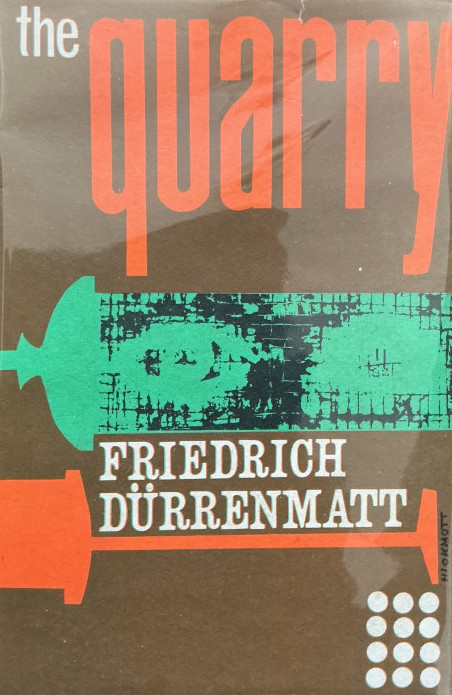
The Quarry by Friedrich Dürrenmatt
I’ve previously reviewed two of the Swiss author’s novels (here and here) and I came to The Quarry knowing that I should expect to discover his trademark style – prose stripped to the bone, the minimum of exposition, characters developed by suggestion and inference rather than deep psychological analysis and very little descriptive flourish. And, fair to say, that’s precisely what I got with this slim detective thriller heavy with the sort of post-war guilt that must have been in the atmosphere of Middle European countries in the late 40s and early 50s.
The aging Police Inspector Hans Bärlach is in hospital receiving treatment for cancer which may be terminal. He contemplates both his retirement and his mortality until one day his friend and doctor, Samuel Hungertobel looks at a magazine photograph of the Nazi war criminal, Dr Nehle and seems to be given a rather unpleasant surprise. Bärlach’s police instincts are alerted and under some pressure, Hungertobel confesses that this monster from the concentration camps bears a remarkable similarity to a medical colleague he knows as Fritz Emmenburger, who claims to have spent the war in Chile writing learned medical papers.
Once Bärlach has his teeth into the chase, his illness takes a back-seat in his mind. He is visited by a Jewish friend, Gulliver, a mysterious figure that comes and goes through the hospital window, who tells him about the way Nehle would operate on prisoners without anaesthetic – Gulliver being one of his victims. These stories of this horror prompt the detective to get himself booked into the private clinic now run by this so-called Emmenburger in order to confront him as a war criminal.
And, as far as plot is concerned, I don’t plan to go further than this because the story of what happens to the detective is where the drama lies and you wouldn’t want me to spoil that for you. What I will say is that the ending is probably the least satisfactory part of the story for one or two reasons but primarily because it is hugely improbable and feels a little like the author got his main character into a spot he couldn’t easily extract him from without taking a liberty.
I think opinion is split amongst critics as to whether Dürrenmatt is a better playwright than a novelist and given I’ve never read or seen his plays, I’m hardly in a position to add to that debate. What I can say is that it’s very clear to see his dramatic instincts at work here: dialogue carries a lot of weight and the scenes have a set-piece, theatrical feel about them. This might also account for the stripped-down nature of the prose I mentioned earlier but I think there’s a fine line to be drawn between lean and mean and stark – and I’m not certain this novel stays on the right side of that divide.
The Quarry was originally called ‘Suspicion’ in German and in many ways this is a more satisfying title because the issue of lurking doubt and suspicion captures the pace of the novel better, in my view, than the suggestions of dynamic action inherent in the idea of the chase for a quarry.
I’m not sure the book is still in print or has been available in paperback in recent times. Hardback copies are available on the second hand market but expect to pay over £10.
Terry Potter
April 2026