
Inspiring Older Readers
 posted on 04 May 2026
I Never Promised You a Rose Garden by Joanne Greenberg
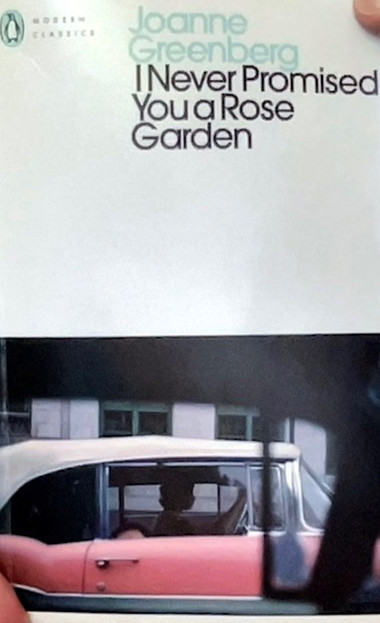
It’s curious how we develop completely mistaken ideas about some books without ever having opened a copy. For years I mistakenly thought that Joanne Greenberg’s 1964 novel I Never Promised You a Rose Garden was some kind of sensational American family saga, perhaps a bit like Peyton Place. And even after the film of the novel was released to great acclaim in 1977 and the book became a bestseller its significance escaped me. It took the elegantly presented Penguin Modern Classic edition pictured to make me investigate it properly – proof if it were needed that the physical appearance of books makes an enormous difference to how we consider them.
Anyway, it is a novel of mental illness, of schizophrenia and psychosis, and in its way is really quite extraordinary in what it attempts to do; doubly so, given that it was written over sixty years ago.
The novel concerns the young Deborah Blau, the fourteen year-old daughter of Latvian Jewish immigrants, Esther and Jacob. Deborah can be regarded as Joanne Greenberg’s alter ego: an afterword by the author makes it clear that this is a fictionalised autobiography, written as a novel rather than as a ‘straight’ autobiography because this allowed her some space to look more objectively at what she had experienced – it gave distance and enabled her to write about what might otherwise have proven impossible. It also helps to know, I think, that she says in her afterword that she left the secure psychiatric hospital in rural Illinois in 1951, so the novel opens I think some time in the late-1940s, shortly after the end of the Second World War.
Deborah’s parents have been increasingly concerned about her irrational behaviour and bouts of self-harm. They are advised that she must be hospitalised – what today I suppose would be the equivalent of being sectioned. But Deborah doesn’t consider herself ‘ill’ or ‘mad’. How can she be – indeed, how can ordinary people be ‘mad inside’, she wonders, when out in what passes for the sane world six million Jews have just been murdered in the Reich’s death camps and killing pits and gas chambers: Jewish people like themselves.
As a way of coping with her mental anguish Deborah has withdrawn into an imaginary kingdom called Yr (pronounced more or less like ‘year’, I think), which is rich with its own foundation myths, culture, social hierarchies, deities, language and customs. Initially, Deborah had been regarded kindly in Yr, personally befriended by high-ranking members of Yr society, known even to Anterrabae, the Falling God, who calls her ‘Bird-one’. Deborah’s fear is not that she will become more ill, ‘crazier’; it is that the outside – Midworld – may make her well and in so doing make it impossible for her to return to Yr.
While Deborah is attended by a Dr Fried, a kindly and accomplished psychiatrist, the regime of the hospital (over which Dr Fried appears to have little control) is brutal and punitive: anti-psychotic medication, the bestowal and removal of privileges, isolation, ‘wet packs’ (restraints and wet, iced blankets), a much-feared ‘violent ward’ for psychotic patients; repeated slapping by staff (ostensibly to halt ‘hysterical’ episodes) is not unusual. Not surprisingly, in this hostile environment, Deborah becomes more ill; and the more ill she becomes, the more she falls out of favour in her inner kingdom of Yr. The Pit (where Yr banishes wrongdoers), the Censor (a sort of chorus of critical voices) and even Anterrabae, the Falling God, begin to persecute Deborah for lapses in her behaviour, for revealing secrets of Yr to outsiders, for endangering the Kingdom.
During this time – and as far as it is possible to tell from the internal structure of the book, Deborah is hospitalised for several years, frequently in the ‘violent ward’ – visits to see her are extremely restricted; she sees only her mother, and for the briefest of visits, typically months apart. Her own anguish and that of her parents (have they done the right thing for their daughter? can this possibly be right? what will happen if she can’t be made ‘well’?) make for sometimes disturbing reading.
But I will admit that I struggled with the book, and I wonder whether my reaction would have been the same had it been written as a straightforward autobiographical account. I’ll try and explain. It is evident from the language and structure of the novel that Greenberg put immense care into her construction of the Kingdom of Yr. And while I think we are meant to experience it as a fantastical kingdom, it is important that we also understand that for Deborah it is a ‘real’ place, a refuge — but one that in her illness gradually ceases to offer safety and becomes a further source of persecution. Our interpretation of the novel and our understanding of what Deborah experiences depends on this.
But I’m afraid that at times – and I am aware that this is my failing and not that of the book itself – it felt to me as if I was reading ‘fantasy literature’ and I struggle with the conventions of fantasy – invented deities, rulers, myths, customs and languages – and so I struggled with Greenberg’s detailed descriptions of the Kingdom of Yr, especially in the later stages of the book where separation between Yr and reality is wafer-thin and Deborah increasingly falls back on the language of Yr to convey what is happening to her, or refers to other characters, staff and other patients, sometimes by their proper names and sometimes by the names they are known by in Yr.
Consequently, I wasn’t able to finish it. And yet even while the ‘fantasy kingdom’ element defeated me, I was aware of the sophistication of Greenberg’s methods and her genuinely extraordinary and ground-breaking attempt to convey the lived experience of mental ill-health. It is a courageous book, and an important one and yet even now, in an era when mental health has what sometimes seems an unprecedented prominence in public discourse, still nowhere near as widely known as it should be. I hope that this elegant new Penguin edition will introduce it to more readers and that more of them will persist where I was unable to. I shall try again at some point in the future.
Alun Severn
May 2026