
Inspiring Older Readers
 posted on 10 May 2026
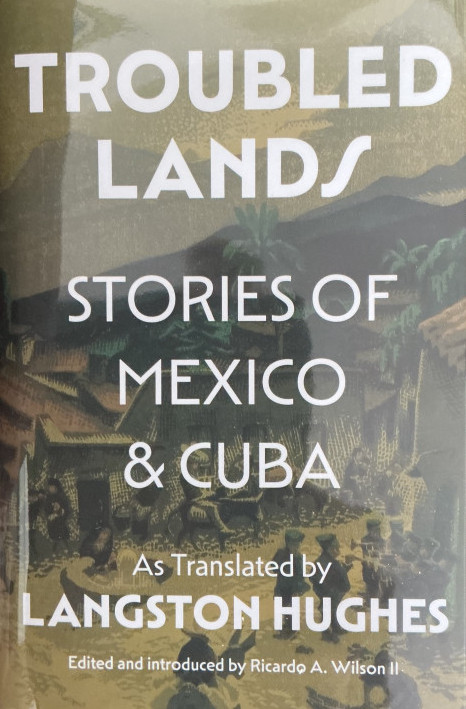
Troubled Lands: Stories of Mexico & Cuba translated by Langston Hughes
I want to start this brief review with a word of praise for Princeton University Press who have done us all a huge favour by finally publishing this collection of short fictions written by eighteen Mexican and Cuban authors and translated by Langston Hughes. It’s a volume of stories that Hughes had envisaged publishing in the first half of the 1930s but which, for various reasons never saw the light of day in the format Hughes had imagined until now. Individual stories appeared sporadically in various periodicals and magazines but the collection as a whole was torpedoed for what were ultimately political rather than literary reasons.
A word of praise also for Ricardo A. Wilson II – associate professor of English at Williams College and founder and executive director of the Outpost Foundation, a residency and arts advocacy organisation for writers of colour from the United States and Latin America – who has provided a really helpful and informative introduction and has overseen the curation of the collected stories into their original intended format. He also gives us a potted biography of the authors Hughes was translating which gives us a very useful addition dimension.
Lanston Hughes had a lifelong affinity and association with Mexico and in 1934 when he moved to Mexico City for what would be a five month stay, he began the process of translating these short fictions. At this point in his career Hughes was already building his reputation as a leading poet and literary star of the so-called Harlem Renaissance and had developed strong left-wing political sympathies, a world view that he found in the Mexican and Cuban stories he wanted to translate. In a letter to a friend, he described them as exploring “the revolutions and uprisings, sugar cane, Negroes, Indians, corrupt generals, [and] American imperialists,” and are “mostly all left stories, because practically all the writers down here are left these days.”
But the strong politics that can be found in the stories was almost certainly the reason why the collection as envisaged didn’t make its appearance until now. Hughes’s agent, Max Lieber, understood that the political climate in the States certainly wasn’t conducive to a friendly reception for work seen to be explicitly ‘Communist’. And the climate got even worse after the Second World War as communist paranoia took hold and having identifiable left-wing sympathies was enough to get you black listed at the very least.
But now we finally have the full roster of stories that Troubled Lands was always meant to be. As the jacket of the book tells us:
“Troubled Lands features thirty-three stories by eighteen writers, including Rafael Felipe Muñoz, Nellie Campobello, Lino Novás Calvo, Luis Felipe Rodríguez, Germán List Arzubide, Pablo de la Torriente-Brau, and Juan de la Cabada. The collection depicts Mexico in the wake of its revolution and Cuba in the years between the brutal regimes of Machado and Batista.”
For me, the quality of the stories is, Inevitably, variable – some are strong, even shocking, while others are a little more throw-away. Ricardo Wilson is honest enough to acknowledge that not all the critics who read the stories at the time Hughes translated them felt the quality was all it should be. He quotes the response of Max Lieber, for example, who said “not a single one of these people, judging by the work you have sent me, can hold a candle to you.”
But, if I was to give you advice on how to approach this book, I should say it’s best to give the stories some space: take time to read them as individual literary events and don’t simply rush from one to another because the mood shifts are too much to sustain that cover-to-cover approach.
The publication of this book is undoubtedly a significant literary event and it is available now from your local independent bookshop – who will be glad to order it for you if they don’t have it on their shelves.
Terry Potter
May 2026