
Inspiring Older Readers
 posted on 20 May 2026
Portrait of a Murderer: A Christmas Crime Story by Anne Meredith
I’ve recently been reading a number of crime stories reissued in the British Library Crime Classics series, which has specialised in recovering and reprinting a number of ‘forgotten’ novels from the so-called Golden Age of crime fiction in the 1920s and 1930s right through to the second half of the 20th century. It’s an admirable venture and they’ve given the books tremendous eye-appeal through a sort of design coherence – you can’t miss the way the books look on the shelf. Having said all that, it is also true that every now and then a book just somehow doesn’t feel as if it belongs in that house style, in what feels like nostalgic or vintage package that plays to a sort of ‘cosy crime’ prospective audience.
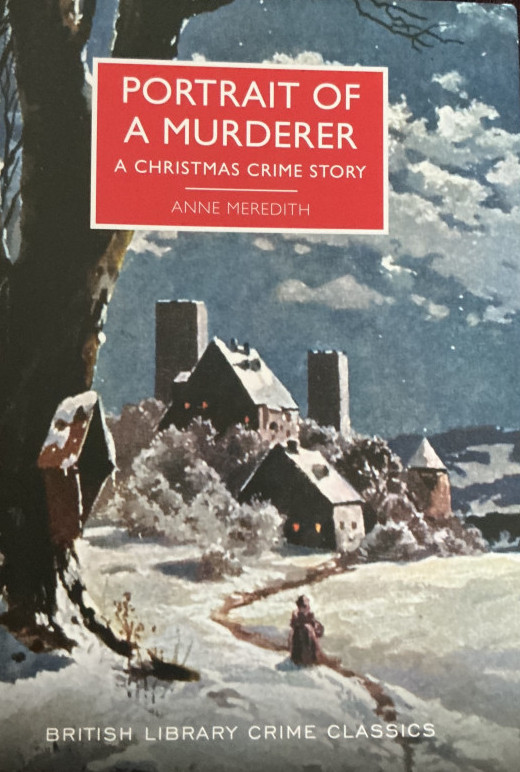
One such book is Anne Meredith’s Portrait of a Murderer which is a surprising and innovative book that belies both its sub-title, A Christmas Crimes Story, and feels very much as if it’s dressed in entirely the wrong jacket. I’m guessing that both publisher and booksellers would think this book is designed to be the sort of Christmas crimes story that only really sells in the festive season – but what a shame if it’s consigned to that fate. It is, in fact, only coincidently a ‘Christmas’ book – the action takes place over Christmas Eve and Christmas Day but the fact of Christmas is only of marginal importance in that it acts as a reason to bring together one of the most dysfunctional families you’ll ever encounter between covers.
Originally published in 1934, the book was written by Anne Meredith one of the pseudonyms of Lucy Beatrice Malleson (1899 – 1973) who was, perhaps, better know for her Arthur Crook series of detective novels written under the pen name of Anthony Gilbert. She was a member of The Detection Club (https://en.wikipedia.org/wiki/Detection_Club) and in that context, the structure and purpose of Portrait of Murderer rather takes you by surprise.
I am giving nothing at all away when I say that from very early on in the book we know the murderer, how the murder happened, why the murder happened. Meredith’s interest lies elsewhere: what are the motives, what is the impact of committing murder on everyone involved, what other sins get flushed out and ultimately what the consequences are. No-one remains untouched.
Adrian Gray is the ruthless paterfamilias and business tycoon who, every year, brings his extraordinary and hugely dysfunctional family together for Christmas. His five children and their respective spouses all arrive on this occasion with a range of disputes, axes to grind and a desperate need for money – which they are hoping to lever out of their father. There’s just two snags: he doesn’t want to give his money away and, perhaps more significantly, he’s just discovered he lost all his money on unwise speculative projects.
His one son, we discover, is in the grip of even more desperate need than the others – and they themselves are on the edge – and he murders his father in a rage, clubbing him to death with a paperweight. What follows is his attempt to cover his tracks and redirect suspicion elsewhere and we, with the aid of the author, are allowed to follow what happens as we get intimate portraits of the couples and see how the seams are all popping open under the stress of the situation.
I’m deliberately not filling you in on the detail because that detail is really the whole point of the book: what goes on in the mind of a killer and what does a murder do to a family that turns in on itself?
This is an unconventional and daring novel that deserves to be better known than it is. The scarce first editions are hugely expensive and so The British Library has done us all a favour by making it available for us all at well under £10 for a second hand edition. I just wish it had the jacket it really deserves rather than what looks like a cheap Christmas card…
Terry Potter
May 2026