
Inspiring Older Readers
 posted on 26 May 2026
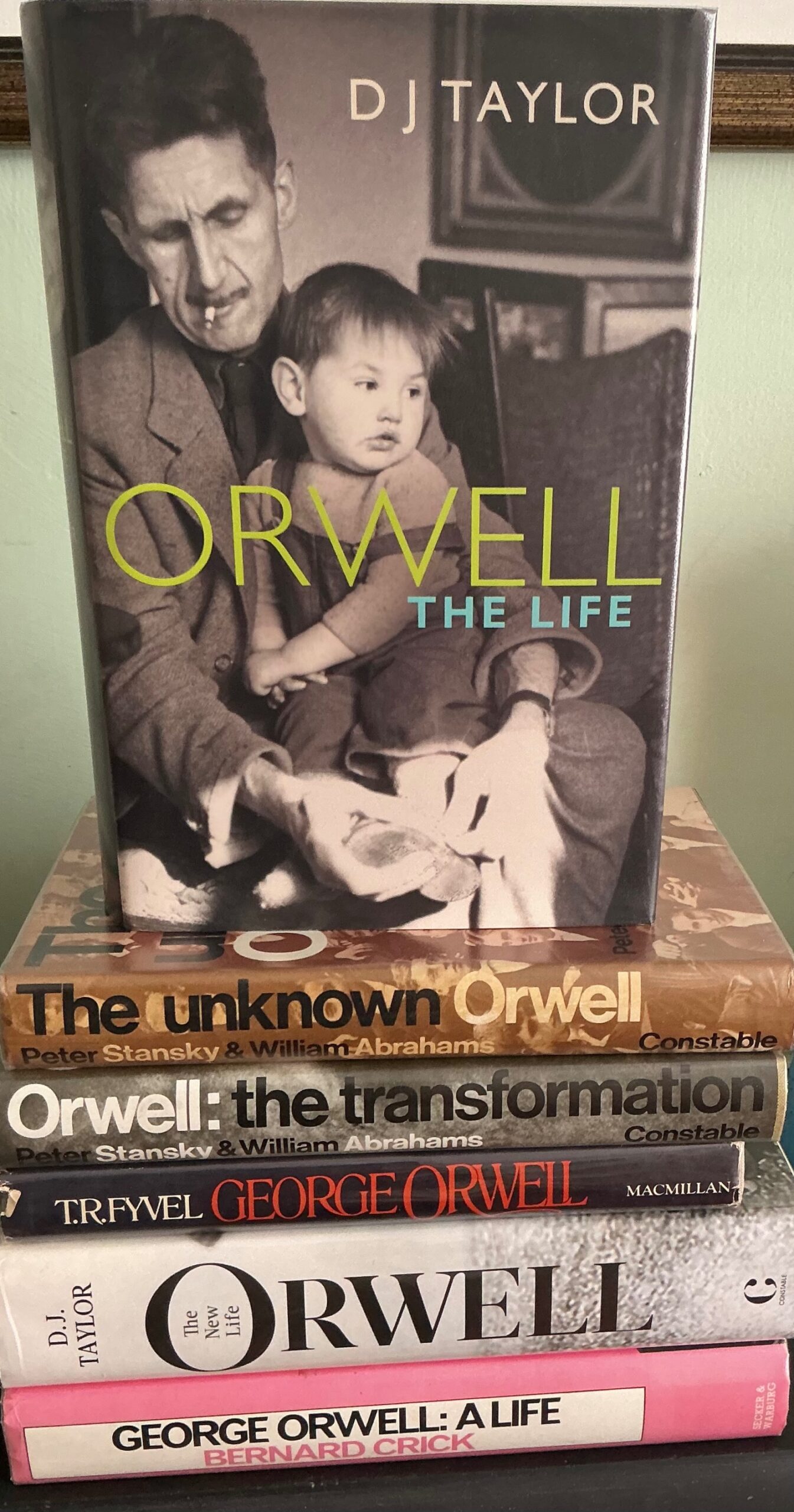
Orwell: The Life by D.J. Taylor (2003)
Over the past few weeks I have been rereading quite a bit of Orwell – dipping yet again into the Collected Essays, Journalism and Letters, especially what he was writing and saying in the lead-up to leaving to fight in Spain in 1937 during the Spanish Civil War. I have always felt that this period in Orwell’s life is rather mysterious, that he suddenly makes a leap of consciousness or commitment that somehow can’t quite be accounted for.
For instance, he had published his first work, Down and Out in Paris and London, some of the journalism that has become amongst his best known (Shooting an Elephant and Bookshop Memories, for example), his first three novels (Burmese Days, A Clergyman’s Daughter and Keep the Aspidistra Flying), and the ‘mature’ (but politically controversial) The Road to Wigan Pier, but even so he was still only really scraping a living on the margins of the literary world. And moreover he lived some distance – both geographically and intellectually – from the centre of literary life in London, having just moved into the The Stores, a fairly primitive cottage in Wallington, Hertfordshire, which as the name suggests had previously served as the village shop.
And yet something propelled him in the course of just eighteen or twenty months to leave behind his almost nineteenth century Grub Street existence and travel to Spain to fight fascism. And so I found myself turning to the first of the two biographies of Orwell that D.J. Taylor has published (this, the first, is from 2003; his second, Orwell: The New Life, is from 2023) – partly to try and fill this gap and partly to try and answer a question that had been nagging away at me for some time: are multiple biographies of Orwell really necessary?
Taylor openly admits that the time leading up to Orwell fighting in Spain (where he was shot through the throat and lucky to survive, incidentally) remains a shadowy period in his life and concludes that if Orwell ever did fully explain what motivated him then it seems he did this in conversations with long-dead friends and comrades rather than in print, and sadly these conversations, along with all those who knew the man at first hand, are now lost to us.
There are then lacunae in any life story which a biographer cannot be held responsible for. But I did think that Taylor’s (first) biography also fell a little short in some other respects. Curiously, there are times when I don’t think it is very clearly written. His prose sometimes gives the impression of haste, of congestion and I lost count of the number of passages I had to reread in order to be sure that I had understood them correctly (this seemed more pronounced in the first half of the book).
Also, I don’t think Taylor is as sure-footed in his understanding of the shifting terrain of the pre-and post-war British Left as some other writers have been and personally I think Stansky and Abrahams (his earliest biographers), Bernard Crick (the first full-length biography) and perhaps especially Ian Angus and Orwell’s widow Sonia Orwell, the joint editors of the Collected Essays, Journalism and Letters, all do a better job of this – perhaps because they were of the Left and were writing closer to the period concerned.
But where I do think Taylor scores is in telling, incidental details. For example, one of the things that I still find astonishing about Orwell’s life is the minute sums of money he lived on – as did many others, of course – but in Orwell’s case the salient point would seem to be that his poverty was chosen. He was ‘ascetic’, he practiced ‘an almost monastic poverty’, he was a ‘fugitive from the camp of victory’: those who actually knew Orwell describe the extraordinary life he insisted on in a variety of ways, but all mean something close to what Gordon Comstock in Keep the Aspidistra Flying described as being ‘against the money god and all his swinish priesthood’.
Taylor estimates that at this time Orwell’s literary earnings rarely exceeded £2 a week and with his landlord’s permission (in a letter to a friend Orwell said he wanted to be sure there wouldn’t be a rent hike the moment he decided to ‘buy a new bacon slicer’) he re-opened The Stores, to serve as Wallington’s village shop because despite the tiny market which existed for it he felt the profit would at least cover his weekly rent of seven shillings and sixpence on the cottage. And on his return from Spain, wounded and in poor health, his financial situation was even more precarious. He was gestating a new collection of substantial critical essays – Inside the Whale – which Gollancz published just as war broke out. But the advance he received for this was just £20 and worse still it was also a commercial disaster, selling only about 700 copies before the rest were incinerated in a German bombing raid.
Here’s another vignette. On the 7th September 1940, as hundreds of German bombers targeted London Docks, Orwell was making his way across London to visit his old friend Cyril Connolly (founder and editor of Horizon, one of the most influential war-time journals and a significant outlet for Orwell’s work), at his flat in Piccadilly. Connolly was another old Etonian but they had known each other since their prep school days at St Cyprian’s, about which both of them eventually wrote. The docks became an inferno and there was a danger too from falling shrapnel and flying debris. Orwell ‘took shelter in a Piccadilly doorway, just as he might have done if sheltering from a summer rain shower’, Taylor says, and then walked on to meet Connolly. Also present was another Spanish Civil War veteran, Hugh Slater, an important figure in the development of the Home Guard, for which Orwell had also immediately volunteered, believing the initiative vital to Home Front defence as well as having the potential to become a kind of revolutionary people’s militia. It is a scene that offers an extraordinary glimpse into a vanished world of war-time intellectual life.
I am also grateful to Taylor for other nudges that have suggested new reading approaches to Orwell that I hadn’t previously thought of. For instance, I had only ever considered his extended pieces The Lion and the Unicorn, The English People and Notes on Nationalism as three disparate pamphlets in a frantically busy writing life, but Taylor regards them as a vital ‘triptych’ in which Orwell worked out his views of ‘Englishness’ and this is certainly how I shall look at them when I next read them.
As I said, one of the reasons for reading Taylor’s book was to try and decide whether multiple Orwell biographies are really necessary, and it turns out that I’m still not sure. I don’t think I have yet read one that I would call ‘definitive’, but in any case perhaps to even hope for such a thing is mistaken. (You can read what early Orwell scholar Peter Stansky had to say on that subject in a piece in The Literary Review from twenty-three years ago.)
I think the view I am gradually coming to is that as the period of Orwell’s life recedes ever further into the past those of us who feel compelled to try and find traces of him will probably continue to look for these wherever they may be; for in a sense we are constructing our own biographies, each one different, each cherishing a slightly different aspect of the man, and we labour at these as we can. Thankfully, there are also memoirs of Orwell written soon after his death by those who knew him at first-hand – Richard Rees’s George Orwell: Fugitive from the Camp of Victory (reviewed here), T.R. Fyvel’s Orwell: A Personal Memoir and George Woodcock’s The Crystal Spirit: A Study of George Orwell (reviewed here) – and I feel sure I shall be revisiting these very soon.
Alun Severn
May 2026
There are numerous Orwell-related articles on Letterpress and all the links can be found in this digest.