Inspiring Older Readers
 posted on 31 May 2026
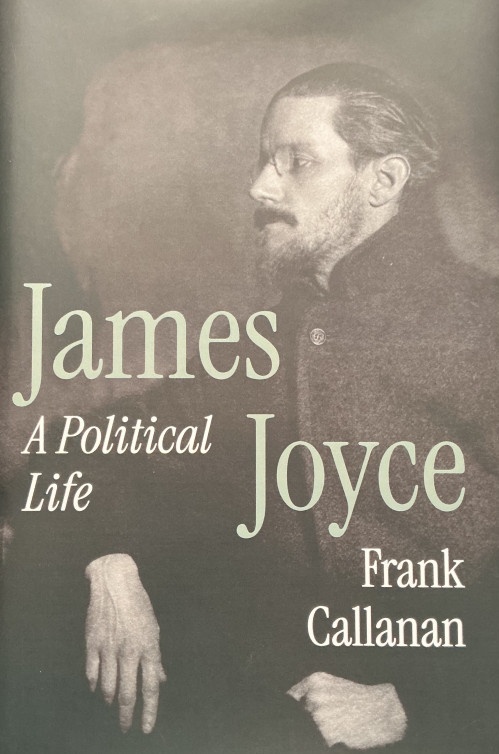
James Joyce: a Political Life by Frank Callanan – an invitation to a reading project
This article is something of a departure from the way we try and review new books here on the Letterpress site. We sometimes get offered the chance to do a review of a book that’s just been (or is due to be) published and we pride ourselves on not just reproducing the publisher’s notes on that book but really reading them – so that we can give a fair reflection of what we think the strengths and weaknesses may be.
However, when we were sent Frank Cullanan’s James Joyce: A Political Life it soon became clear that it was necessary to take a different approach on this occasion. It’s a book that runs to some 900 pages in its hardback state and it took the author 15 years to write. In fact, the author sadly never lived to complete it (he died tragically in 2021) but he did agree a publishing deal with Princeton University Press before he died and they have enabled a team of editors to bring it forward for publication: a tribute to Callanan and a blessing for the academic community who will be fascinated to see the efforts of all that scholarship.
So, this is a massive book in every sense of that word and needs to be read taking time and diligence – it may not take me the same length of time to read as it took for the author to write it but it demands and deserves time to be given to it to do it justice. It seems only right, given this, that I take a different approach with this piece and that is why I’m inviting you to think of joining me on what would be a reading project, something to be completed over time. In that way you can think of this less as a review and more as a signpost pointing you towards this book and allowing you the chance to get your copy and start your study.
So let me tell you what I have discovered so far – just to get you started. Frank Callanan (1956 – 2021) was an Irish barrister, historian and scholar who became increasingly fascinated by James Joyce, Joycean studies and very particularly, Joyce’s politics. In the Editor’s Preface to the book, they reproduce some of Callanan’s 2006 lecture ‘Joyce and the Historian of Modern Ireland’ in which he says:
“My interest in Joyce is in some respects deviant. What I most enjoy in Joyce is his treatment of the Irish political, and of Irish history. I believe the acuity of Joyce’s political sensibility, especially in relation to the Ireland of his lifetime, has remained weirdly underestimated and under-analysed.”
And that, in a nutshell, provides you with the underpinning motivation for the writing of this book. Callanan locates the Parnell Affair (see here for more detail https://www.irishamerica.com/2021/06/parnell-and-kittya-love-story/) as the single most important influence on the young Joyce, one that would shape his thinking about Ireland, Irish nationalism and also find its way into the fiction. The book’s flyleaf notes put it this way:
“Joyce was eight years old in 1890 when the O’Shea divorce scandal tore Irish nationalism apart, leading to the split in the Irish Parliamentary Party, the death of nationalist leader Charles Stewart Parnell, and a long, bitter period dominated by the anti-Parnellites. This was the Ireland that Joyce grew up in and rebelled against, and which determined his literary direction.”
For those, like me, who hold much of Joyce’s writing dearly and find it an unending source of new ideas and new ways of seeing, a new political biography will be a fascinating project – and I stress that term ‘project’ – and for academics making a greater and in-depth study of the life and works of Joyce, this is surely a must-have. But it will take time to read and digest and I’ll leave you with the words of Robert Spoo of Princeton University who wrote the book’s Foreword because it may give you a sense of the kind of considered read you’ll be entering on:
“There is something Proustian in the opulent architecture of Callanan’s account of Joyce, as well as in his story of the young Irishman’s search for lost political time.”
Available now from Princeton University Press and you’ll be able to get a copy from your local independent bookshop – who will be happy to order you a copy if they don’t have it on their shelves.
Terry Potter
June 2026