
Inspiring Older Readers
 posted on 25 Jun 2026
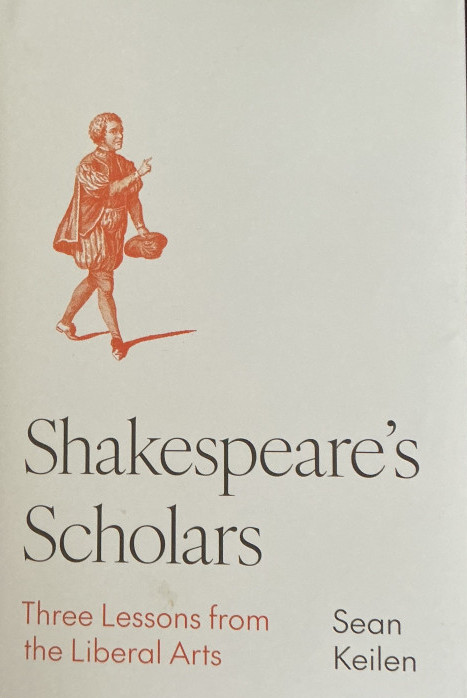
Shakespeare’s Scholars: Three Lessons from the Liberal Arts by Sean Keilan
This is not a long book (130 pages or so) and despite its somewhat forbidding title, it’s written in a very accessible style and, deliberately, in a way that tries to avoid obscurity of language or overly-complex analysis. That’s not, by any means, to suggest the ideas and arguments that you’ll find here are simplistic or superficial – quite the opposite. And it’s very much a book that spoke directly to me: let me explain why.
I spent the last fifteen years of my working life as a Senior Lecturer in a university and, having come from a background in community engagement and voluntary sector development, I was constantly trying to deal with the way that researchers, experts in their field, scholars of standing seemed to (unconsciously in many cases but not all) exclude the non-scholar, the lay-person, those not from the world of academia by an exclusivity of language and communication. The more convoluted and complex ideas could be made the better and the creation of a lexicon all their own underscored their elevation from the grubbiness of the ordinary people.
You’ll be aware, I’m sure, of the age-old critique of academics that they live in ‘ivory towers’, untouched by the realities of the ‘real world. In Shakespeare’s Scholars, Sean Keilen, professor of literature at the University of California, Santa Cruz, confronts these issues head-on and seeks to demonstrate how it’s possible, though an interpretation of Shakespearean text, to discover just how academics who love their subject can keep it connected to real people and real life.
At a time when the teaching of the humanities is under unprecedented threat, re-establishing the way that something like the study of English Literature can be essential to a healthy society and a healthy communal pot of ideas is more necessary than ever.
In his own work as an academic, Keilen ‘frequently explored (Shakespeare’s plays) with members of the public in community education programmes I organised with a professional theater company’ and this persuaded him to think more about why it was that so many of Shakespeare’s plays contain characters who are from a scholarly or academic background and what the playwright had to tell us about them.
“….I hope it will demonstrate that the study of literature is, among other things, an opportunity to see the truth about oneself through the eyes of another person and the fact that great works from the past are resources for discovery, growth and change.”
And, just to add my own emphasis on the message, they are resources for everyone and it is the role of the scholar, the academic, the teacher to make them accessible to everyone not to tie them up and keep them prisoners in the tower.
Keilan presents us with three ‘lessons’, three close studies of Shakespeare plays – Love’s Labours Lost, Hamlet and The Tempest – all of which have the practice of scholarship at their heart. It’s from these studies that he draws out three guiding principles that should guide the scholar in their studies: to be humble, to seek wisdom and to know yourself. These he argues need to be applied not just to ourselves as individuals but to the institutions of education too.
We need to be engaged in a process of defending and nurturing the humanities as ‘a longstanding tradition that interprets our common humanity cogently’. But it’s in a perilous state as anyone looking at the world of higher education can see and I can do nothing better than end with the author’s own words:
“The tradition is fragile and needs our care, but if we put our faith in its wisdom, we could use it to guide ourselves and our institutions through periods of rancorous strife to new ways of living with each other in peace.”
Available now from Princeton University Press, you will be able to get a copy from your local independent bookshop – who will be happy to order it for you if they don’t have copies on their shelves.
Terry Potter
June 2026