
Inspiring Older Readers
 posted on 30 Jun 2026
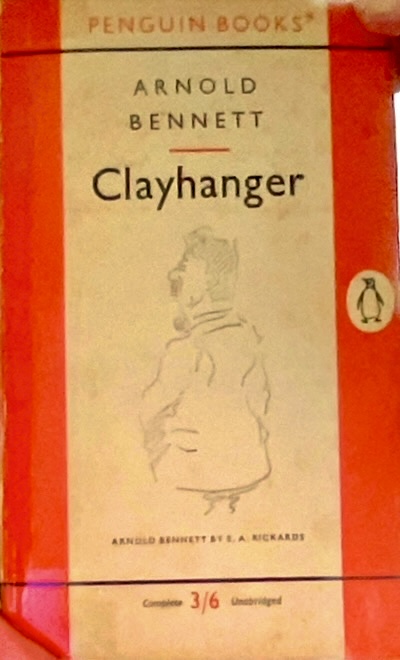
Clayhanger by Arnold Bennett
‘He braced himself to the exquisite burden of life.’
– Clayhanger, Arnold Bennett
This isn’t the first time I have read Arnold Bennett’s Clayhanger, but I first read it so long ago that I had no real recollection of the novel itself and moreover whatever I have come to understand of Bennett’s methods and the awesome scale of his ambition derives from much more recent reading of his work (review links below).
So bear with me while I take a few minutes to remind myself about what makes Arnold Bennett such an extraordinary novelist.
He famously argued with Virginia Woolf in the 1920s insisting that the creation of character was fundamental to the purpose of fiction and that without the presence of living, breathing, believable characters the novel would die out. What he meant by this, I think, is that fictional characters must exist in absolute relationship to their environments in the widest sense – the societies, landscapes, places, economies, work, trades and social and political attitudes that form (or perhaps hinder) their lives.
His models in this were the nineteenth century French realists, Maupassant, Flaubert, Balzac and Zola and with extraordinary audacity he transplanted these techniques of social and character analysis to the small and deeply provincial pottery-making towns of Staffordshire.
But the other important element in Bennett’s approach is time itself and I think this is at its most apparent in Clayhanger. Although published in 1910, it takes place entirely in the last quarter of the nineteenth century. This enables Bennett to take a sort of All-Seeing Eye perspective, pointing up ironies and dated prejudices and misconceptions – misplaced notions of modernity, a blindness to industrial pollution, child labour, working class poverty: all public ills which just twenty or so years later even the late-Victorian mind has begun to find deplorable. He brings a sharp, sceptical eye to bear on all forms of cant and social and religious hypocrisy but he is also a slyly funny writer.
It is essentially a coming-of-age story – the rise to adulthood of Edwin Clayhanger (and more tangentially his sisters, Maggie and Clara), the children of Darius Clayhanger, a print-shop owner and businessman in Bennett’s fictionalised Potteries town of Bursley (actually Burlsem).
But really it is poverty and its obverse – not really wealth as such, but respectability – that is the main theme of the novel, for what we know, but neither Edwin nor any of the other characters know, is that what haunts Darius Clayhanger, ‘steam-printer’, is a fear of poverty, of falling into the lower depths, a return to the municipal workhouse from which he was rescued as ‘a seven year-old man’ by the kindly Shushions, a Sunday School superintendent who saw something saveable in the young Darius. We see Shusions again later as an impoverished and increasingly senile old man, and to some degree it is his decline and death that begins Darius Clayhanger’s own decline.
But what of Edwin Clayhanger? While a lot does happen in this novel of over five-hundred pages, it is not a story of earth-shattering drama or tragedy. Rather, it is a novel of the ordinary – what Bennett described in his letters and diaries as ‘the interestingness of existence’. As a boy Edwin becomes interested in art and wants to paint. He meets Osmond Orgreave, an architect and the head of a wealthy neighbouring family, also the father of his oldest school friend, and he sees in the man the kind of cultivated tastes and cultural inquisitiveness his own father markedly lacks. Under Orgreave’s guidance he begins to see for the first time the built environment around him in all its haphazard grandeur and mediocrity and squalor, and for a while can imagine no greater calling than to become an architect. But these early dreams are dashed. As far as his father is concerned Edwin is and always has been destined for the family printing business and a central part of the modest drama of the novel is Edwin’s assuming of the mantle of responsibility – of himself becoming a ‘steam-printer’.
And so we see Edwin grow to become a respected Bursley businessman; he still dabbles with watercolours, he manages to collect and sometimes even read the sort of beautiful leather-bound volumes he first saw being shown off by one of the Orgreaves’ sons. But business – and proving himself to his father – must come first.
The key event, however, is Edwin’s unconsummated love affair with Hilda Lessways, a friend of the Orgreaves, who mysteriously flees Bursley almost as soon their love for each other is declared. A decade later he finds she is married and that the young ‘nephew’ temporarily being cared for by the Orgreaves’ oldest daughter is in fact Hilda’s son. He discovers that Hilda is running a failing boarding-house in Brighton where she is facing bankruptcy and he intervenes and saves her from the debtors’ prison. Here and there bigger public affairs intrude – the Home Rule crisis of Gladstone’s premiership, striking potters forced bitterly and hungrily back to work, the rise of the early Labour Party, the recurring influenza pandemics of the final decade of the nineteenth century, to name just some.
Clayhanger may not be one of the great state-of-the-nation novels, such as Dickens would write. Rather, I think the task Bennett set himself was that of rescuing a small slice of Potteries society from the oblivion of history – and it is his towering achievement that this novel of late-Victorian life remains not just palpably real but recognisable and relevant to a modern readership. A marvellous novel.
Alun Severn
June 2026
Arnold Bennett elsewhere on Letterpress:
Anna of the Five Towns by Arnold Bennett
The Old Wives’ Tale by Arnold Bennett
Riceyman Steps by Arnold Bennett