
Inspiring Older Readers
 posted on 05 Jul 2026
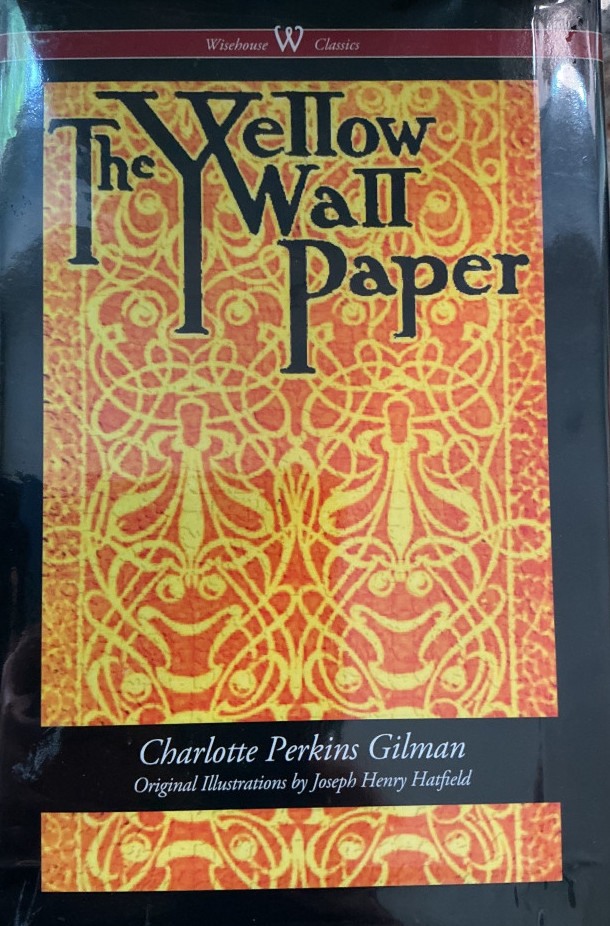
The Yellow Wall Paper by Charlotte Perkins Gilman
Charlotte Perkins Gilman (1860 – 1935) will almost certainly be a name more immediately recognised in her native USA than over here in the UK. Gilman was an early vociferous advocate of women’s rights and social justice and much of her writing and academic work was dedicated to those causes.
It may well be that if you have come across her name before it will be because of her remarkable short story, The Yellow Wall Paper, which was first published in The New England Magazine and which has subsequently gone on to become the all-time biggest seller on the Feminist Press list (https://feministpress.org/). That is quite something for what is a story of just 30 pages.
But, of course, like all the very best short stories, its depth and scope burst the bounds of its length and this one has attracted interpretations that cover issues such as the treatment of mental health conditions, the control of women by men, the role in fiction of the unreliable narrator and it’s even been claimed as one of the classic gothic horror stories. It’s a story that is so full of possibilities that, unusually in my experience for something with just 30 pages, it merits a hardback edition in its own right.
The Yellow Wall Paper draws heavily on Gilman’s own experience of postpartum depression and the experimental therapy known as the ‘rest cure’. This involved effectively closeting the patient in a room and allowing them no intellectual stimulation at all. Essentially, doing nothing and having no access to outside stimulation with the aim of focusing on bonding with the child. Gilman’s experience of this approach exacerbated her symptoms rather than alleviating them and brought her close to total breakdown. In her short story, an unnamed young woman, also suffering from postpartum depression is subjected to a similar treatment and finds herself isolated in a room by her dominant doctor-husband – John – and finds herself increasingly fascinated, even mesmerised, by the wallpaper that covers the walls of what increasingly feels like a cell.
All of this we discover through and from the woman herself as the story is presented in the form of a journal that she is keeping as the ‘rest cure’ is imposed upon her. What we are witnessing is a woman slipping precipitously towards madness – seemingly being herded there by a husband who ‘knows best’ what she needs. But what we don’t find out is just as mysterious and tantalising and that leaves us with a series of hanging questions: what has this mysterious room with wrecked wallpaper and gnarled furniture been used for before; is there some malign ghostly presence in the room influencing her; how reliable is she as a narrator?
But the most extraordinary and vivid thing about this story is the wall paper. The intricate yellow patterns seem to come to life, to draw her in until she begins to be convinced that there is the moving figure of a woman trapped behind the pattern, seeking release. She (and we?) come to elide herself and this trapped figure as she finds a way of physically rubbing herself around the wall as if she were herself seeking to escape the wall patterns. The story ends with an extraordinary image that I won’t reveal here because it’s powerful and you’ll want to read that for yourself.
As I indicated earlier in this review, it’s a short story that feels like a much longer one and it will stay with you long after you’ve finished reading. If you’re anything like me, the themes it raises will prompt readers to keep changing their minds about what the dominant messages of the narrative are and I expect that internal debate with myself to continue. I must say in all honesty that I stumbled over it entirely by good fortune and I’m so glad I did. There are plenty of paperback editions available and none of them are expensive – so you’ve not go much to lose and lots to gain.
Terry Potter
July 2026