
Inspiring Older Readers
 posted on 09 Jul 2026
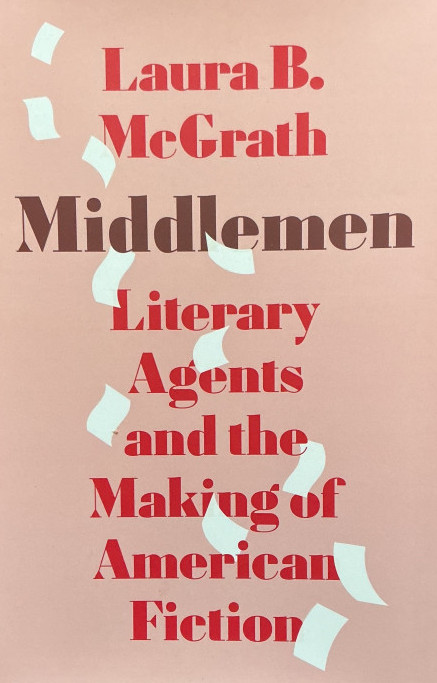
Middlemen: Literary Agents and the Making of American Fiction by Laura B. McGrath
I love it when a book comes along about a topic I’m already fascinated by but which then gives me a new perspective on it – a way of thinking that just hadn’t really dawned on me. I’ve read, collected, sold and promoted books for fifty years or more and I’m conversant and comfortable with the roles of authors, editors and publishers but I can honestly say that the existence of the literary agent is something I’ve only vaguely been aware of, had no real understanding of and hadn’t given much thought to their role in the literary ecosystem.
Laura McGrath, assistant professor of English at Temple University has written a book, Middlemen: Literary Agents and the Making of American Fiction, which has opened my eyes to what turns out to be a crucial part of the machinery that brings books from the author to the reader and which, for me, was hiding in plain sight. Although McGrath focuses on the American literary scene, I’d be fairly sure that many of the practices she uncovers apply to the world of book production across the globe – although clearly the names, the agents, the authors and, to some extent the historical context of the key institutions would be different for the British publishing establishment.
So, for me, I was less concerned with the individuals and personalities than I was with the more abstract and philosophical role of the literary agent, a figure which, McGrath insists, is now so integral to bringing books to readers that it’s impossible to imagine a literary landscape without them. Her argument is, as the jacket blurb claims, that:
“agents act as advocates, matchmakers, negotiators, and tastemakers, and they must balance artistic values with the commercial imperatives of publishing conglomerates.”
‘Middlemen’ she explains is a slightly tongue-in-cheek title given that some 80% of the literary agents are female but it is often their taste and their judgement that determines which manuscripts find their way to publishers. She uses ‘original archival research, data analysis, and interviews with scores of agents and other publishing professionals’ to try and pin down what makes a literary agent tick and what ultimately makes them successful but, in the end, I was left feeling that there a handful of key messages that almost defy systematic evidence collection:
The literary agent embodies the essential commercial nature of publishing. Although these agents would pretty much all see themselves as concerned with the literary quality of the writers they uncover and promote, it is the economic ‘viability’ of the author that determines whether they are kept on their books.
- Literary agents, like it or not, have a huge influence on the reading that comes our way. Some like to act as an informal editor and spotting what the market might want is their alchemy – agents perhaps more than anyone, including authors, shape the reading landscape.
- There are no formal qualifications for becoming an agent. Somewhere in the mix of skills they need are those of public relations, advertising, personal charisma, belief in their literary taste and a sort of chutzpah that comes from the social capital they have accrued.
- You have to come to the conclusion that, try as you might, it’s almost impossible to capture the ‘magic’ of their role. This rather nebulous set of instincts for what might fly and what might not has led to the emergence of the ‘first novel’ phenomenon which sees the agent permanently on the lookout for the new, the next big thing and also sees them speedily dispose of those first novelists who can’t replicate their success next time around.
There’s loads more to discover in McGraths book that I can’t dig down to in detail here and I thank her for a readable and revealing study – you don’t have to be an academic mastermind to be thoroughly absorbed by the study. But I have to be honest and say that whilst I have had my eyes opened to the pivotal role of the literary agent in shaping the literary landscape I’m so fond of, I can’t say I’m entirely happy about it. I’m always suspicious of these cultural gatekeepers whoever they are, especially when the whole edifice seems to ultimately depend on money however much the agent erects a curtain of literary taste to disguise the brutality of that relationship.
Available now from Princeton University Press, you will be able to get a copy from your local independent bookshop – who will be happy to order it for you if they don’t have it on their shelves.
Terry Potter
July 2026