
Inspiring Older Readers
 posted on 04 Aug 2026
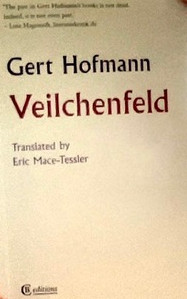
Veilchenfeld by Gert Hofmann
There was a time, probably over thirty years ago, when I had the necessary stamina or determination or whatever to read Holocaust literature quite extensively – some of the huge ground-breaking studies and the landmark testimonies of camp survivors. But I now find I can’t do it; the horror is overwhelming and in any case, some of what I recall from first reading books such as Martin Gilbert’s magisterial The Holocaust, for instance, feels seared into my mind.
But I find that I do have a continuing interest in the imaginative literature of the Holocaust, especially that later generation of European novelists (say, born between about 1930 and 1945), because I find that their work takes a more oblique approach to the Holocaust. They may be writing in its long, inescapable shadow, but their novels seem haunted by its presence rather than explicitly about it. Writers like W.G. Sebald, for instance, seem to approach the Holocaust from a tangent of inexplicable loss, a sense of dislocation, a profound sadness.
Another notable feature that several of these writers seem to share also interests me and that is what might be called a High European aesthetic – a ‘modernist’ style that isn’t as experimental or as fractured as perhaps the first wave of modernists but is nonetheless slippery and elliptical. Narrators are often unreliable, tenses uncertain and shifting; speech marks have typically been abandoned; sentences are often long and sometimes meandering or deliberately repetitive, as if language (and perhaps even consciousness itself) cannot entirely be depended on; there is often what seems a deliberate distancing – the use of archaic language, for example, or the conventions of earlier genres, such as gothic literature or the folk tale. There is often a dark, wry humour, although at times – as in Thomas Bernhard’s case – this may rise to a kind of rancorous, incantatory lamentation.
Anyway, to those better known names must now be added that of the German novelist, Gert Hofmann, whose extraordinary 1986 novel Veilchenfeld was published in 2020 by the tiny independent publisher CB Editions, in its first English translation. Hofmann was born in 1931 in Saxony and died suddenly from a heart attack aged just sixty-two in 1993.
Veilchenfeld is avowedly a ‘Holocaust novel’ in that that is what it is ‘about’ and it concerns the persecution, decline and death of a Jewish professor of philosophy, roughly during the period 1936 to 1938. Under Hitler’s racial laws he is first removed from his university post and then increasingly restricted in every other way: where and when he can leave the house, what he can buy and where, the administrative offices he can visit, where he can live, whether he can travel or leave the country. Nazi thugs beat and humiliate him. What we see is his gradual decline, his dissolution, and the eagerness with which the community of this small country town rushes forward to persecute the lone, elderly Jew who has come to live in their midst.
While Veilchenfeld is clearly a ‘Holocaust novel’, it does share some of the traits I tried to outline above. But it also has some other characteristics that are arguably more significant. For example, at no point do the words Jewish or Hitler or Reich or Nazi appear, nor indeed any of the other tortuous, bristling compound nouns inherent to Nazi ideology; we only know the period incidentally from a mention quite late on in the book of the year 1938; and most importantly, the narrative perspective throughout is almost entirely that of a ten year-old boy, Hans, the son of the local doctor. His father treats the ageing Veilchenfeld – increasingly clandestinely – while also reluctantly admitting to himself that it would probably be best for all concerned if Veilchenfeld would choose to take his own life; it is a doctor’s dispassionate assessment of a patient’s slim chances of survival.
Hans observes Veilchenfeld’s increasingly circumscribed and miserable life with puzzled, childish curiosity and innocence, unaware of the full implications of what is taking place. He sees but does not – cannot – understand; in stark but unspoken contrast, of course, to everyone else.
I read its 143-pages slowly and lingeringly. It is not a book to rush or skim. I found myself paying close attention to how Hofmann does what he does, aware that careful technique was being employed but paradoxically finding that this somehow heightened rather than diminished the impact of the novel.
One would have thought that one of the major publishing conglomerates would have snapped this up, but no: once again we are indebted to that legion of improbably small, shoestring independents that survive by the seats of their pants and yet nonetheless seem able to publish fiction of genuine international significance. Highly recommended. I will certainly be looking out for what little else there is in translation by Gert Hofmann.
Alun Severn
August 2026