
Inspiring Older Readers
 posted on 09 Aug 2026
The Master of Go by Yasunari Kawabata
In 1938, Kawabata was commissioned by the Mainichi newspaper corporation to cover what turned out to be a marathon game of Go that eventually took six months to settle and played out in several different locations. Kawabata has used some of the notes he made for these reports to construct a semi-fictional novel, The Master of Go, published in 1951, that is subtle, enigmatic and, I think, quite difficult for a Western reader to get to grips with.
The starting point, I suggest, is to try and get a rudimentary grasp of why the game of Go is such a Japanese cultural edifice. Instead of me giving you a butchered synopsis, you might find it useful to take a look at this explanation:
https://voyapon.com/go-game-rooted-in-japanese-culture/
But, even though the book contains diagrammatic illustrations of some key moves, I found it easier not to focus on the game itself but to think more about the way Kawabata used it as an extended metaphor.
The game itself involved the established grand master, Honinbo Shūsai – a traditional and quite conservative player – and the up-and-coming young pretender Minoru Kitani (who is renamed Otaké in the novel). In the end, the daring young challenger emerges victorious and, in that clash and its outcome, Kawabata sees a way of talking about the bigger political and cultural future of Japan. The game comes to symbolise the passing of an old order and the emergence of a new one with a different world view. The subsequent history of Japan in the late Thirties and Forties is clearly the central concern of Kawabata who actually considered this his finest novel (which is a pretty big claim given his other work).
The contrast between the temperaments of the two antagonists is at the heart of the book and it’s impossible to avoid a certain nostalgia in the way Kawabata sees the impetus draining from the old traditional approach of Shūsai and the patiently calculating predatoriness of the challenger. There’s only ever going to be one winner but what will be the implications for Japan?
“From the way of Go, the beauty of Japan and the Orient had fled. Everything had become science and regulation.”
This is a novel short in length but impossible to see as brief. For a start, it’s a book that needs to be taken slowly to appreciate the subtlety of the prose (I’m dependent on the translator here – Edward G. Seidensicker), appreciation of detail and the extraordinary tension between the two players over an extended and exhausting playing schedule. And, of course, if you also want to get to grips with the details of the game itself and how that metaphor works, you’re going to have to invest some considerable time with it.
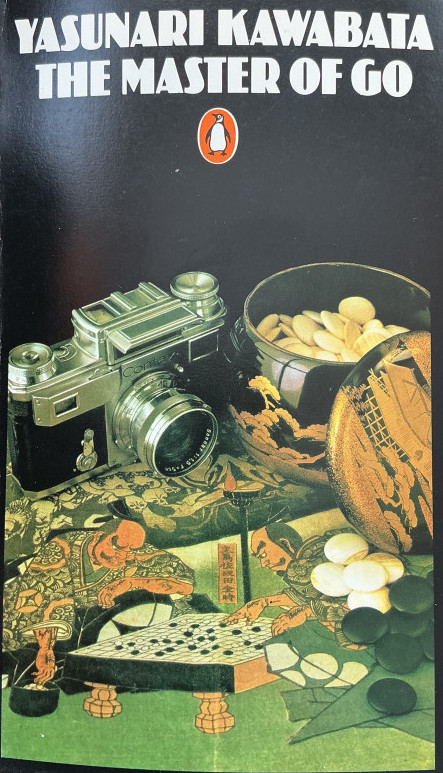
Paperback editions are not hard to find and not too expensive. My copy, the one shown in the picture above, is the 1976 edition but there is a repackaged, rejacketed new Penguin available now too.
Terry Potter
August 2026