Inspiring Older Readers
 posted on 27 Aug 2026
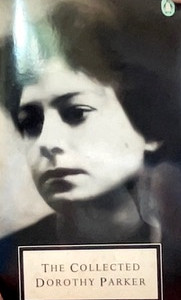
The Collected Dorothy Parker
I was discussing with a friend recently whether the American writer, wit and drinker, Dorothy Parker, was worth rereading. We had both been somewhat infatuated with her when we were in our twenties. So I rummaged out my elderly copy of the Penguin Modern Classics The Collected Dorothy Parker and dipped in.
The problem – actually, one of the problems – is that Parker’s output is rather bitty. She was published in The New Yorker, Vanity Fair, Esquire, Ladies’ Home Journal, Cosmopolitan, and Life, and that is only a partial list, and she wrote short stories, soliloquies (one-person stories, usually a woman, framed as a sort of interior monologue), endless light, satirical verse, theatre reviews and a book column called Constant Reader. She wrote most often for The New Yorker, where she was a staffer from its inception in 1925. The other problem is the ‘wit’. But more of that later.
I still don’t quite know what to make of the stories I have so far read. To be honest, I thought I knew what to expect and it turns out I was wrong. They aren’t the whip-smart, wise-cracking humour that tends to characterise virtually everything else she wrote. They struck me as much more acutely observed than that, often superbly written, and strongly evocative of New York in the Twenties and Thirties and just before and during the war years. They tend to have a dark, tragicomic view of the world and of people’s snobbery and hypocrisy. They aren’t of the calibre or complexity or gravity of, say, Scott Fitzgerald’s, but I think they do have echoes of his work, along with Hemingway (whom she considered a grand master of the form) and the colloquial dialogue-driven style of, say, Ring Lardner. I suppose what I am trying to say is that they are more serious than I remembered – by which I mean, more serious in their intent. Where they seem let down, I feel, is in their endings: some of them simply didn’t seem strong enough, fading out rather than reaching a finale. But as I say, this may be an unfair and ill-informed view: I really do need to read more of them.
The verse – and there seems quite a lot of it in this collection – I skipped over, for the simple reason that I have never understood its appeal. When her verse collections were originally published they sold in vast quantities – presumably to people who don’t really like or want poetry as such, but do enjoy ‘comic verse’. It now seems to be a form that has fallen entirely out of fashion and I find it hard to imagine anyone today reading Parker specifically for her poetry.
The forty or so book columns she wrote in The New Yorker as Constant Reader seem almost to constitute a separate body of work. As many of Parker’s admirers have pointed out, the Constant Reader columns aren’t really ‘book reviews’ exactly. One critic has said that they are closer to stand up humour. Fran Lebowitz, another US writer and wit with much in common with Parker said of them, ‘Does anyone know how hard it is to be that funny?’ Others prize their gimlet-eyed observation, their often harsh (but rarely merely flippant) judgements.
I read far more of the Constant Reader pieces than I expected to – partly to see how long it would be before my frustration got the better of me. Because sadly, they are marred by an almost constant facetiousness – but frustratingly are also full of brilliantly executed, insightful judgements, often with more economically expressed truth in them than most literary critics manage in a lifetime. Of Hemingway, for example, she said: ‘…Hemingway stands a genius because [he] has an unerring sense of selection. He discards details with a magnificent lavishness.’ But read one after another, my God, a little goes an awfully long way.
If you’ve read this far you will probably have gathered that this time round I am struggling to make sense of Parker’s reputation. But I’m far from alone in this. I was surprised to find that in his introduction to the 1977 Penguin Modern Classics edition, Brendan Gill – also a writer for The New Yorker and someone who worked tirelessly to preserve Parker’s literary legacy – considers it necessary to try and explain ‘the high place she held in the literary world of forty or fifty years ago’ and ‘the critical disregard into which she subsequently fell’. He goes on to suggest that Parker played to the gallery of New York’s small, self-aggrandising literary world, chasing its easy acclaim by producing more of the kind of acerbic wit and repartee it so admired. But this was a high-stakes game, he says, for sooner or later the ‘second- and third raters’ who made up New York’s literati would be swept aside – and there was a danger that Parker too would be swept aside with them.
And this, I think may go to the heart of why reading Parker today can feel something of a chore. There is such a lot of it, and so much of it is spoiled by a relentless chasing of ‘wit’. And on the page, I think nothing dates quite so quickly nor as badly as ‘wit’. (And perhaps by that I mean especially ‘wit’ of The New Yorker magazine variety.)
However, I think her short stories may have more to them and so I am continuing to explore these in the hope that if I read them attentively enough, I will discover that Dorothy Parker is a better writer than I thought. But judgement is in the balance. There may be more to them overall but a prevalent theme seems to be Bright Young Things (and especially the no longer quite Bright enough or quite Young enough) in forlorn, privileged relationships, endlessly bellyaching about their forlorn relationships. There: I’m starting to sound like Constant Reader…
Alun Severn
August 2026