Inspiring Older Readers
 posted on 15 Sep 2026
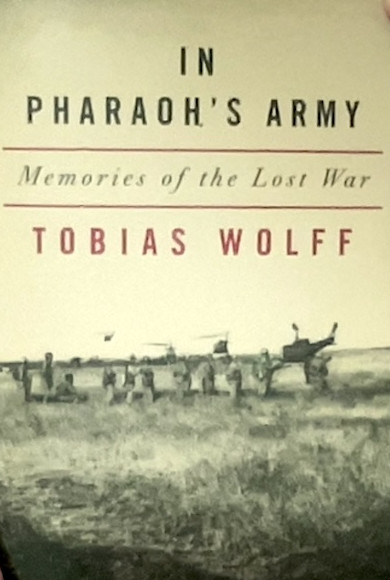
In Pharoah’s Army: Memories of the Lost War by Tobias Wolff
It’s curious but I think that sometimes the virtues of a particular book are best revealed by reading another that works in an opposite way. Let me try and explain.
Recently, I have been rereading memoirs of the Viet Nam war. I began by rereading Michael Herr’s extraordinary reportage Dispatches, a classic of the New Journalism style and instrumental in helping to establish the genre back in the 70s. I was surprised to find that it was ten years since I last read it and reviewed it for Letterpress. It was the year that Michael Herr died; perhaps it was his death that prompted me to reread it. While acknowledging that it was ‘utterly of its time’ and that some aspects hadn’t worn well, I thought it was marvellous and said that its language, its vision, its period authenticity and its relevance will never fade. And I still think that.
But for some reason, rereading it this time I felt slightly disappointed. Somehow, I couldn’t quite enter into its spirit. Eventually I came to the conclusion that I wanted something that told me about the Viet Nam experience in more conventionally informative terms – because most certainly, this is not Herr’s approach. Dispatches is very much a book that assumes its reader is already steeped in the political, social, human and historical tragedy that was the Viet Nam war, precisely as Herr’s generation of chroniclers were, and moreover is reading in enduring opposition to the war. (This, incidentally, can no longer be taken for granted and if you look online you’ll find that in some of the strangest corners a process of revisionism has been busy transforming it into a glamorous endeavour, a time of real warriors and real heroes.)
Anyway, I digress. So I left off and turned instead to Tobias Wolff’s wonderful memoir, In Pharoah’s Army (a considerably later work than Herr’s – it was published in 1994). I admire everything Wolff has written but rereading this convinces me that it may well be his masterpiece.
I began to see what Wolff offered and how it differed from Herr’s hallucinatory reportage. For a start, they are written from very different positions. In Dispatches we get the perspective of those – journalists, photographers, war junkies, adrenaline freaks – who chose to be there, actively wanted to be there, who saw their role as a vital bearing witness. By contrast, Wolff was an enlisted man, not drafted. He had joined the army in the mistaken belief that it would provide him with a training in, I suppose, manliness; and he chose Viet Nam because he believed that it would offer some kind of validation, that it would redeem him from the shame he felt at his family circumstances – a mother somewhat distant and preoccupied with a new marriage; an absent father, a cheat and a liar who served prison time for fraud; his own unsettled teenage years, his desire for more, for better, for whatever it was that would enable him to write. Wolff has documented this elsewhere in his coming-of-age memoir This Boy’s Story, but these scarring early years, a persistent feeling of ‘imposter syndrome’, of not belonging, or perhaps more accurately of not having worked out precisely where he could or should belong, are present in some way in this and virtually all he has written.
Whereas Dispatches plunges us straight into the craziness of Viet Nam’s jungle warfare, and seems even now to be written in a language freshly minted in order to convey the unbelievable, In Pharoah’s Army takes a more circuitous route. For example, its thirteen chapters have the shapeliness and narrative coherence and dramatic elegance of the best of Wolff’s short stories; they also share the same probing moral integrity, unafraid to examine even the most personally shaming episodes. Not all of the chapters take place in Viet Nam – we see the couple of years prior to enlisting when Wolff served as a seaman onboard a research vessel, and we see him at military language school in Washington where he learnt Vietnamese and we see him during training in the officer corps. This background is important because it shapes what he will be and do in Viet Nam, where he served as an officer-grade military advisor to a regiment of Vietnamese Army troops in the south of the country.
These various characteristics give In Pharoah’s Army a perspective that we don’t often see in other memoirs of the Viet Nam era. It is a more artful and self-examining work than Dispatches, while also offering dramatic insights into life as it was lived in Viet Nam during the war. And as with Herr’s book, albeit for different reasons, in Wolff’s too it is language that is the real star. His prose is subtle, supple, of the utmost clarity, at times funny, ironic, tragic. Whereas Herr seems to be writing from the very crucible of war in a hip, countercultural language that is being invented as it hits the page, one gets the impression that Wolff’s prose is the result of immense quiet effort undertaken over years, honed and honed until he was satisfied that it could convey the moral ambiguities and complexities of the Viet Nam years. I’ll give just one taste, but in reality I could have chosen a passage from virtually any page. Here he is describing the doomed US military base of Dong Tam, the nearest to where he was stationed:
‘At Dong Tam I saw something that wasn’t allowed for in the national myth – our capacity for collective despair. People here seemed in the grip of unshakable petulance. It was in the slump of their shoulders and the plodding way they moved. A sourness had settled over the base, spoiling and coarsening the men. The resolute imperial will was all played out here at empire’s fringe, lost in rancor and mud. Here were pharaoh’s chariots engulfed; his horsemen confused; and all his magnificence dismayed. A shithole.’
Anyway, reinvigorated by Wolff and better able now to see the very different virtues of both his book and Michael Herr’s, I shall return to Dispatches and finish it. And once I have done that I may well follow-up with what I always think of as the third in an exemplary trilogy of personal war memoirs – photographer Tim Page’s Page After Page.
Alun Severn
September 2026