
Inspiring Older Readers
 posted on 20 Sep 2026
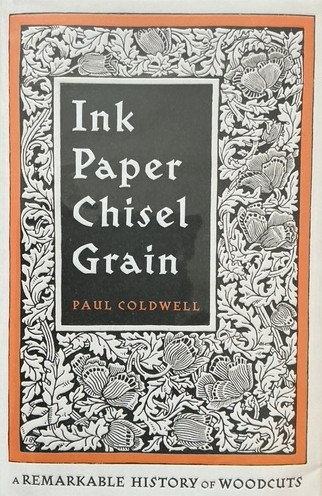
Ink Paper Chisel Grain by Paul Coldwell
I’ve written before on this site about how much I admire the art of the woodcut (see here) and as I’ve gained a deeper appreciation of that artform my appreciation has continued to grow. So, when I saw this new study, Ink Paper Chisel Grain by Paul Coldwell, I was immediately drawn to it.
Sub-titled ‘a remarkable history of woodcuts’, the book’s author certainly knows of what he writes. On the jacket he is described as ‘an artist, researcher and writer who has worked with and studied printmaking for more than 50 years’. But that only tells part of the story as we find out at the very beginning in his very personal preface which starts with this statement: ‘I am the son of a printer’. As a child he was thrilled by the time he spent in his father’s place of work and the excitement he felt ripples through this book even now. In fact, I think it’s one of the key strengths of this book: it’s very personal, it’s full of enthusiasm to convey that sense of the thrill Coldwell feels and it speaks it directly to the reader.
This most certainly isn’t a dry ‘history of the woodcut’ type of affair but a highly individual series of stops along the way in pursuit of an argument that explains why he believes the woodcut print has changed the history of art and still, in the age of computer graphics, remains relevant and vital. The author conveys his delight for woodcuts and their historical development in almost visceral terms – looking at them with him is an almost visceral, physical experience.
“This book seeks to answer how and why the woodcut, the earliest for of printmaking, has proved to be so resilient over time. I have tried, wherever possible, to have been in the actual presence of the actual prints this book examines, as I believe in the importance of the encounter with the original.”
I really liked the way this book felt like being in the company of a very well informed, authoritative companion speaking to you clearly and directly – this isn’t the dry text of an informed but dispassionate scholar.; rather it’s the work of a passionate enthusiast.
But I have to say much of my enthusiasm for the text of the book is punctured by what seems to me to be an extraordinarily bad decision about the design and presentation of the book itself. If ever a book needed to have its insightful descriptions and analysis of prints illustrated by having the image immediately adjacent to the text, then this is it. Why, for goodness sake, have the (small-size) illustrations that have been included been clustered together in four four-page inserts at intervals throughout the 330 pages of text? That’s really puzzling and annoying decision and I can’t help but feel it’s been done as a budget-saving measure rather than as a sensible design decision.
I think it’s a real shame that the power of what is being said is dissipated as a result but despite that, I’d still want to recommend the text because it’s such a vibrant read.
Currently only available in hardback although I’m sure real enthusiasts won’t mind that – but I guess the paperback can’t be too far away if you’re happy to wait.
Terry Potter
September 2026