
Inspiring Older Readers
 posted on 22 Sep 2026
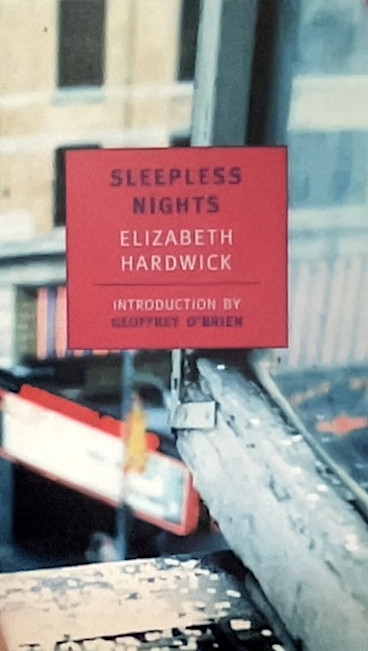
Sleepless Nights by Elizabeth Hardwick
Everything I have read about Elizabeth Hardwick’s extraordinary little book Sleepless Nights (1979) has seemed preoccupied with trying to determine what it is. A plotless novel? An autobiographical sketch? A memoir? Something of all these things? The first few times I tried to read it I gave up, thinking it complex and difficult. And then a day or two back I decided to give it another go and it just clicked. It wasn’t complex or difficult. The exactitude and beauty of its prose was immediately bewitching – idiosyncratic, yes, but immediately bewitching.
Elizabeth Hardwick was born to a large working class family in Kentucky in 1916, the eighth of eleven children. Quite how she rose to be an influential figure in modernist New York literary circles I don’t know. She was an eminent critic and essayist, one of the founders in 1963 of The New York Review of Books. For some years she was married to the manic-depressive ‘confessional school’ poet Robert Lowell, who left her for the English writer, socialite and heiress Lady Caroline Blackwood. (Hardwick was devastated by this betrayal, but with refreshing sound judgement noted in a letter to a friend that Lowell, her ‘Yankee genius’, had left her for the ‘spoiled richness’ of England where he was being fawned over by ‘silly little Tories’.)
Here’s how I picture it. Late one night in the mid-70s, Hardwick, then just sixty or so and living somewhere on Manhattan’s Upper West Side, is intent on trying to order her recollections of a long and rackety life. I imagine her over the years trying various ways of doing this, abandoning each as not quite right – the memoir too obvious, the autobiography too literal, the novel too constricting, the short story too formal. And so she settles on something that is all and yet not quite any of these things, an approach capable of embracing the kind of lucid stream-of-consciousness and vivid jewel-like miniatures she has in mind. And she says to us, and to herself: ‘This is what I have decided to do with my life just now. I will do this work of transformed and even distorted memory and lead this life, the one I am leading today.’
And so Sleepless Nights is born, an irresistible, impossible-to-categorise work of literature that to my mind has echoes of Virginia Woolf (its stream of consciousness, its combination of iron determination and frail delicacy) and of Joan Didion (a sometimes oblique and poetic tone, but never lacking clarity, always concrete).
Memories, fragments of letters to friends (some living, some dead), recollections of specific times and places and events, even quotations from her own past work in other forms (her equally idiosyncratic essays, for example) – all find a place. And yet I suspect that Sleepless Nights is one of those divisive books that readers either love or hate, appreciation of its pleasures heavily dependent on whether or not one takes to Hardwick’s unique voice.
For in the final analysis it is her voice more than any other single thing that is so beguiling – dignified, chastened, gently murmuring, finding new ways to cover old ground, remembering her dead, her friends and her lovers (‘I lived at the Hotel Schuyler…with a red-cheeked, young homosexual man from Kentucky…we were as obsessive, critical, jealous and cruel as any ordinary couple’); her Kentucky childhood (‘Farewell to the precious limestone, to the dynasties of swift horse bones’, the ‘Wrinkled, broken jockeys with faces like the shell of a nut’); the moments of grace that have enchanted her (‘…the rain was beautiful…lavender and silver streaks, gleaming in the mud’, the ‘surreptitious visits to itinerant evangelical tent meetings’). The tumult of a life distilled finally to a kind of calm, an equilibrium of reflection.
And so after several attempts, I learnt that it is best simply to let Elizabeth Hardwick speak for herself. Don’t worry about what kind of book it is exactly; don’t worry if it isn’t immediately clear who she’s talking about. Just try it. It’s very short. Just start at the beginning and listen to her speaking to you. You may hate it. But you may find that you have unexpectedly discovered one of those writers whose voice seems not just immediately identifiable but also somehow already familiar, and already dear, and that you are reading a book you would not willingly be parted from.
Alun Severn
September 2026