
Inspiring Older Readers
 posted on 30 Sep 2026
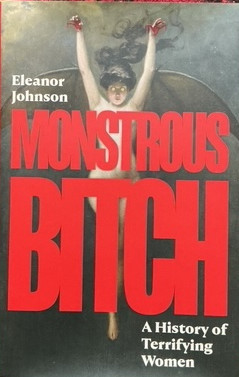
Monstrous Bitch: A History of Terrifying Women by Eleanor Johnson
I wouldn’t normally start with the presentation of the book – especially an academic study – but in this case it’s a significant starting point. The jacket is striking and provocative and it prefigures Eleanor Johnson’s approach to the subject. The large red lettered title, ‘Monstrous Bitch’, over the painting of a naked woman/winged demon looming over us with bloodied hands seems to be an astonishing and regressive image given the fact that this is an examination of how some women have consistently been ‘monstered’ by what the author refers to as ‘The Patriarchy’ – but, in fact, its deliberately and pointedly unsettling.
So, the choice of the word ‘bitch’ is a calculated reclaiming of that word:
“What do I mean by calling her that – a bitch? Why use that word? Well, first, I want to highlight and defamiliarize the rampant misogyny in the English-speaking world, in which the word ‘bitch’ has become an increasingly normalised way to refer to women…… If, as a culture, we are determined to use the word ‘bitch’ willy-nilly to refer to women we should – at the very least – be aware of why the notion of an evil she-dog has the talismanic powers that it does.”
So, what is the argument at the heart of Johnson’s remarkable study? Well, put way too simply, she postulates the view The Patriarchy (the term she prefers to use to describe the state of male domination over society and its institutions that has existed for centuries) needs the idea of the monstrous or demon woman to act as warning or a threat of social instability or chaos. These monstrous women she says share some characteristics – they are sexually predatory, a complex threat to the idea of ‘reproduction’ and often a threat to children and ‘exist in strident opposition to the matriarchal status quo’.
Johnson explores the way this trope of monstrosity has been created and passed on through our cultural inheritance. The book’s inner flap captures the way she progresses this story:
“In a narrative brimming with insight, Johnson traces the origins of female monstrosity to the demoness Lamashtu of ancient Mesopotamia, showing how this infanticidal, hypersexual, loudmouthed monster appears in different guises throughout history. In classical Greece, she reemerges as the sorceress Medea, the child-devouring monster Lamia, and the vengeful Furies. In the medieval and early modern periods, she is an oversexed, baby-slaying, spellcasting witch; in the Romantic and Victorian eras, a vampiress; and in the modern age of psychoanalysis, a mental patient. After this longue durée history, Johnson shows how monstrous bitchery has been challenged and reinterpreted in contemporary cinematic popular culture, becoming an expression of heroism and resistance in films like Ginger Snaps, Jennifer’s Body, and The Witch. She demonstrates how deeply embedded the roots of misogyny have become, and why it is more critical today than ever that we expose and address them.”
Vividly and vibrantly presented, it’s great to be able to report that Johnson, a professor of English at Columbia University, has written this in a style that will be thoroughly accessible by the interested lay-reader as well as satisfying academics with the scope and reach of her research.
Available now from Princeton University Press, you will be able to get a copy from your local independent bookshop – who will be happy to order it for you if they don’t have it on their shelves.
Terry Potter
October 2026