
Inspiring Older Readers
 posted on 08 Oct 2026
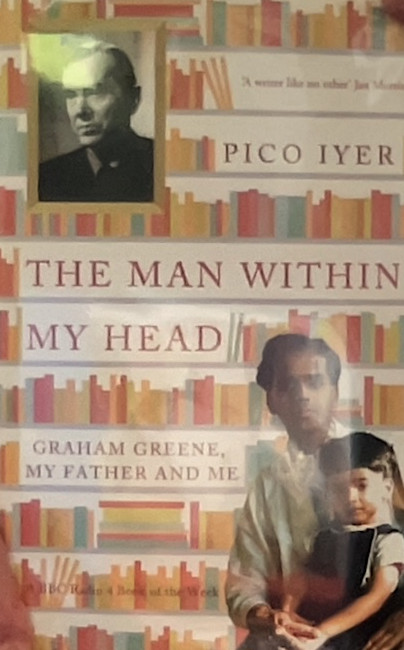
The Man Within My Head by Pico Iyer
Graham Greene is one of those writers whose work – so atmospheric and evocative that it is now a recognised landscape of the mind almost universally known as Greeneland – continues to have an irresistible fascination for other writers, and perhaps especially for a certain kind of male writer.
Pico Iyer is one of these, and The Man Within My Head: Graham Greene, My Father and Me is the story of his obsession with Greene – how Greene has haunted him, and how he in turn has dogged Greene’s footsteps.
Pico Iyer turns seventy next year. He was born to a Bombay brahmin family, and his mother and father were both gifted intellectuals. His father was a child prodigy who was educated at Oxford and became a philosopher and political theorist, professor of political science at the University of California, Santa Barbara, and a member of a US think-tank. Ayer’s mother was an eminent religious scholar and teacher.
In the early-60s the couple relocated their family – Iyer was eight at the time, I think – to California, where they bought a house in the Santa Barbara canyons, on Coyote Road; a house that they would lose within a year or so, along with everything in it, in what became known as the Coyote wildfire of 1964. I mention this because it is all part of the essential background to Iyer’s story.
However, therein lies the first problem I encountered with this book. For the first four chapters his extraordinary family circumstances are only hinted at, and it is not until chapter five that he begins to fill in the (increasingly strange) details. And I found myself wondering: was this just a structural device to make the early parts of the book more mysterious, more dramatic (why is a child repeatedly flying unaccompanied between Oxford and California); or is it that Iyer actually believes that most readers will already know of him and his family, and that given this, the fine detail can wait? Rather uncharitably I came to the latter conclusion.
The reason, by the way, that this child is repeatedly flying unaccompanied between Oxford and California is as follows. The nine year-old Iyer was not surprisingly lonely and unsettled in this strange house in the Santa Barbara canyons. He missed his private prep school in Oxford, the school friends he had left behind, their familiar babel of (posh) voices from around the world, the gently predictable weather, the ancient spires, the rows of Edwardian villas. But he is no ordinary nine year-old and Iyer explains that numbers fascinated him and that he noticed (the way nine year-olds do) how strong the dollar was against the pound, and worked out that he could fly back to Oxford every term to the Dragon School and then back to California for the holidays and that this would still cost less than the progressive school he had been enrolled at, a tiring hour’s bus ride away further up the canyon. He pitches the idea to his parents, and they agree.
Of course, the book does have interesting bits about Greene himself, but I found these sometimes so obliquely delivered that they would probably defeat anyone who hadn’t already immersed themselves in Greene’s novels and at least some of the other books about Greene (his own notoriously partial memoirs, for instance, Ways of Escape and A Sort of Life, or Shirley Hazzard’s short, gossipy book, Greene on Capri, or Marie-Françoise Allain’s collection of interviews with the writer, The Other Man, perhaps even Norman Sherry’s monumental biography). I couldn’t help feeling that any of these other books tell us more that is useful about the man than Iyer does. Even Greene’s curious book Getting to Know the General, about his friendship with Omar Torrijos, the revolutionary and military leader of Panama, I think tells us more about what made Greene tick.
Perhaps I’m being unfair to Iyer’s book. When it was first published in 2011 it was a BBC Radio 4 Book of the Week and so many must have found it enjoyable and engaging. But I found something curiously self-regarding and a bit arch about it. Perhaps I simply didn’t take to the author’s persona. That may sound trite, but when someone filters everything they know about a writer through their own personal history and family circumstances, then to some extent I think we have to take to them personally. We have to want to know what they think of the writer in question, how they arrived at these views and why, and most importantly how their thinking can inform our own understanding and appreciation of the writer.
And on all of these counts, I’m afraid I felt fairly indifferent. I finished the book feeling no more illuminated about Graham Greene than before I opened it.
But I did think what an extraordinary story Iyer’s family had to tell of migration and Empire and social mobility and that this was far more interesting than what he had to say about the writer he idolises.
Alun Severn
October 2026
Grahame Greene elsewhere on Letterpress:
The Comedians by Graham Greene
Our Man In Havana by Graham Greene
The Letterpress Project also features in a post on the Graham Greene Birthplace Trust website