Inspiring Young Readers
 posted on 02 Aug 2026
Turn and Face the Strange (No.1 in a very occasional series)
Back in 1971, David Bowie recorded his seminal album Hunky Dory, which contained the hit single, Changes. This was Bowie’s attempt to get people to notice and maybe understand the emerging youth culture of the time and implores them (and himself) to eschew easy value judgements and to ‘turn and face the strange’. I can’t imagine that Bowie would have ever imagined that this phrase would turn up 55 years later as the heading to an article about odd and interesting books – but there you go, it’s the way culture leaks into unusual corners of existence.
I’ve used Bowie’s words as a starting point for this putative new and very occasional series of articles because it so perfectly captures a type of book hunting that I’ve fallen into – books that are old, interesting and sometimes, frankly, bonkers. Books I might not actually be buying for their content but because they simply have a fascinating backstory or an eccentric mode of presentation.
I recently wrote a review of such a book for this very website – Did It Happen? – a distinctly odd confection by various authors that was built entirely around a gimmicky structure that pits the fiction author against the reading audience to see if the reader can spot true tales from fictional ones. As I confessed in that review, the content as fiction had no real quality (nor, I think, was it meant to) but the jacket art and the gimmicky set-up were the things that really interested me.
Given that I’ve owned-up to finding such oddities irresistible, I thought it might be good to bring you more examples of this kind of eccentricity in the future as I find them and to give these articles an identity; hence Turn and Face the Strange.
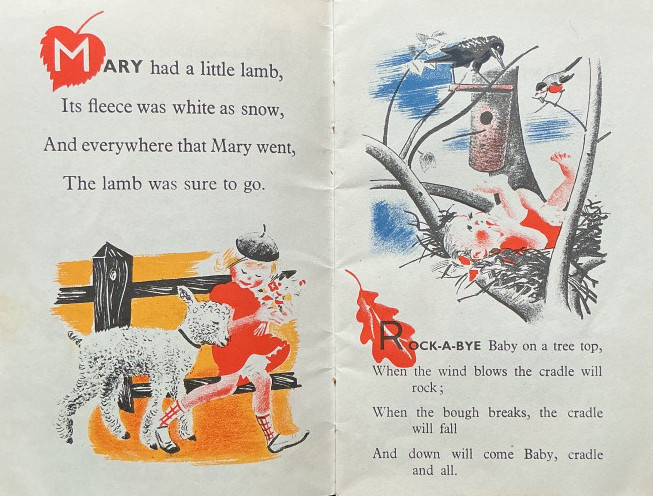
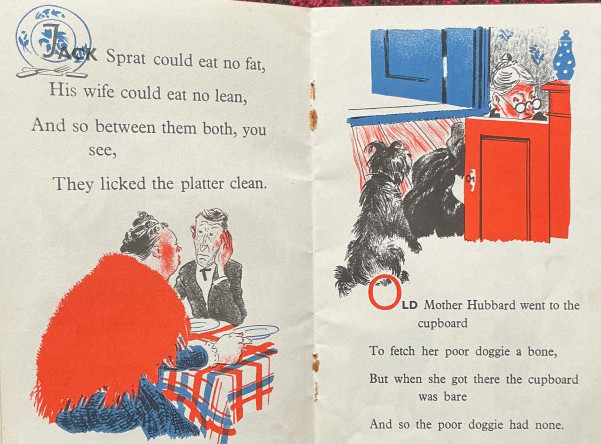
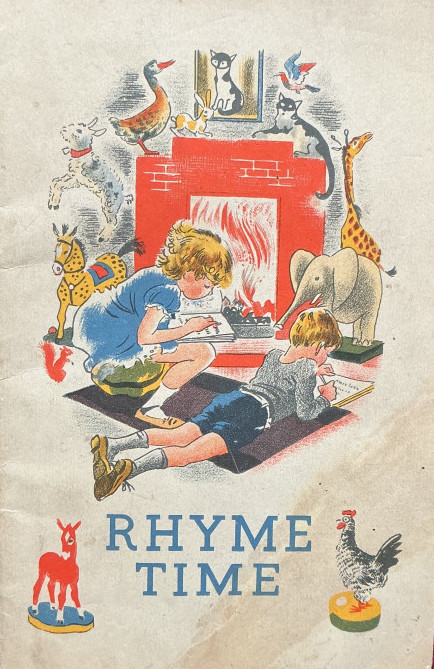
No sooner had I found myself thinking about this than the No.1 for this series popped into my hands – liberated from a pile of 50s royal ephemera sitting on a kitsch 60s drink trolley in the corner of a Tewksbury charity shop (yes, these are the kinds of places I haunt!). At first sight, Rhyme Time, looks like an unremarkable slim card-jacketed book of children’s nursery rhymes for the very young but two things struck me immediately – the period, uncredited illustrations were unusually good and well printed and the little pamphlet/book was in remarkable condition. Worth the £1 asking price I thought. But I really hadn’t even scratched the surface of this little treasure.
This is where it gets strange because I wonder how many of you remember Izal? If you do, it’s almost certainly because you have had a close encounter with those extraordinary medicated sheets of toilet paper that were favoured by the custodians of all school, public and institutional toilets and were like using a stiff, shiny piece of newspaper. Their selling point was that, being coated in disinfectant, public health was being given a boost. It was, incidentally, nonsense and Izal was not especially useful as a health product – nor for that matter as toilet paper.
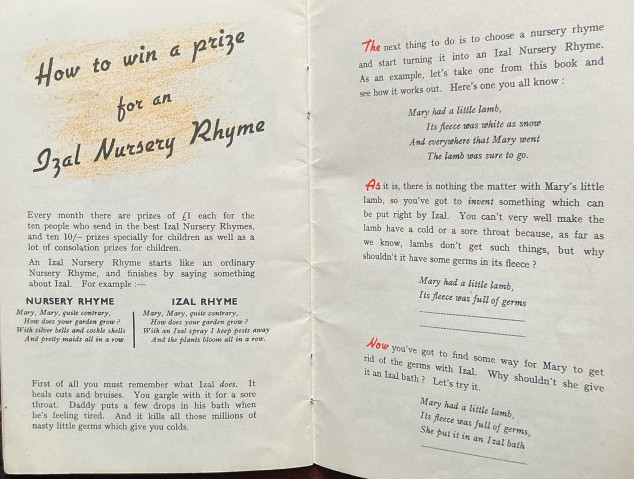
But Izal had existed as a business well before they scooped the public toilet paper market and were manufacturers of disinfectant, antiseptic, bath soak and mouth gargle and, it was to promote this end of the business that the Nursery Rhyme book was produced. Children were invited to send in their own versions of the classic children’s rhymes contained in this little booklet ‘rewritten’ to promote the virtues of Izal products. Ten-pound prizes are on offer to any that get published and, at the end of this booklet, there are useful tips and examples of how to adapt your chosen nursery rhyme.
Here’s what they suggest could be done with one of them:
“Mary, Mary quite contrary,
How does your garden grow?
With an Izal spray I keep pests away
And the plants bloom all in a row.”
Hmmm..
This booklet is in fact dated to 1936 and this is the sixth one in the series – so somewhere out there, there must be others. I challenge you all to find another…
Terry Potter
August 2026