Inspiring Young Readers
 posted on 30 Aug 2026
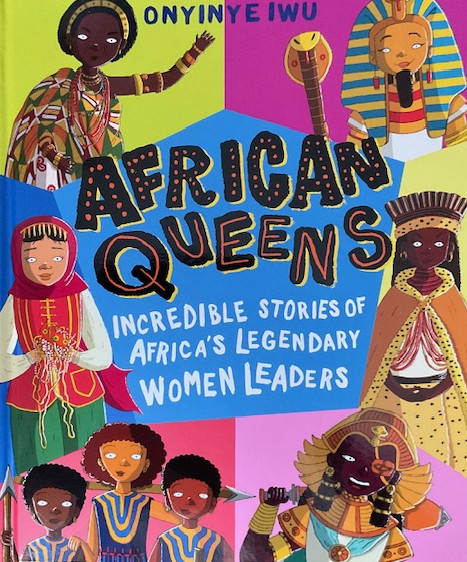
African Queens by Oninye Iwu
I was captured by the subheading for this splendid looking book which is ‘Incredible stories of Africa’s legendary women leaders’ because I realised that I needed to find out who would be included. I suspect that this will be the case for many readers of all ages as relatively little attention is given to teaching about non-European/ American history in schools and elsewhere. As the author explains in her introduction:
‘As a young African girl growing up in Italy, I often felt disconnected from what I was taught in History lessons – Africa only three times: ancient Egypt, slavery and colonisation’.
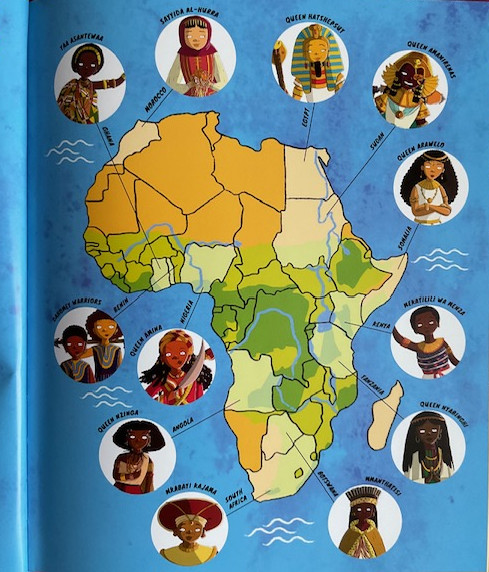
She also points out that not much improved when she moved to the UK and experienced some limited curriculum focus on African American history and the Civil Rights movement during Black History Month. She wanted to show that several significant women had played a part in fighting for what they believed in and in playing their part in making their countries strong and ultimately independent from colonial control. I liked the illustration at the beginning of the book that shows the twelve chosen women linked to their countries of origin on a map of the continent. Although all looked enticing, I decided to focus on just three examples for this review:
Sayyida Al- Hurra circa 1195-1552
Known as ‘The Pirate Queen’, this fiercely independent and well- educated woman was a Muslim refugee from Spain who helped her husband to rule the Morrocan coastal city of Tetouan. When he died, she went on to successfully rule the city for thirty years and worked in partnership with the Barbarossa brothers, who were renowned pirates. Together they attacked and looted European ships as well as attacking coastal towns in Portugal and Spain. Her justification for doing this was that her people had been treated so badly by Spain that her city deserved to benefit from pirate treasure and ransoms for prisoners.
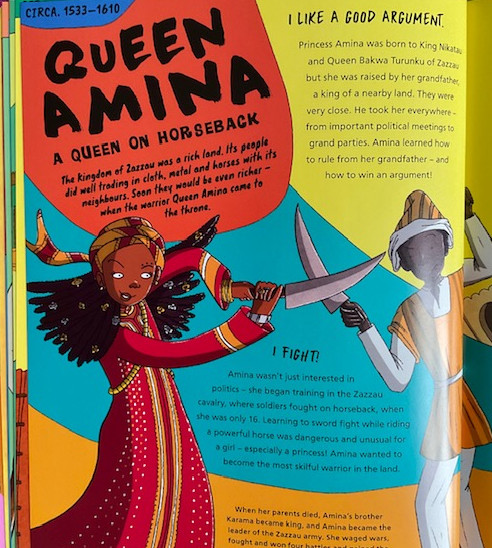
Queen Nzinga circa 1582-1663
She was the favourite daughter of King Kilombo, ruler of Ndongo, a land that would one day become Angola. He taught her to be a fearsome warrior as well as ensuring that she received an excellent education including learning to read, write and speak Portuguese – the language of the enemy. When her elder brother inherited the title, he needed her help because he couldn’t speak Portuguese. I loved the illustration showing her using one of her men as a chair because the Portuguese refused to give her one when she was negotiating a peace deal! She eventually became queen but was forced to leave after some time, later becoming queen of the neighbouring country of Matamba. She is now cited as ‘The Mother of Angola’ remembered for her extensive political and diplomatic wisdom alongside skills in military strategy and bravery.
Mekatilili Wa Menza circa 1840-1924
I found this one particularly interesting because this 70-year-old widow was renowned for being one of Kenya’s earliest freedom fighters. As an elderly woman myself, I was intrigued to learn about how she did this. She belonged to the Giriama people who were peaceful fishermen and farmers – until the British arrived in 1914. Outraged at the dreadful treatment of her people by the British, including expecting them to fight for the British army in WW1, her resistance took the form of performing a sacred dance, called kifudu which she took from village to village, afterwards giving a rousing speech. This influential troublemaker was soon exiled to a remote town but she escaped and was arrested. This time she was exiled to Kismayu in Somalia, but she escaped yet again and returned home. She is now remembered for the way in which she used her dance culture as a weapon of peaceful resistance, a method that is sometimes used today.
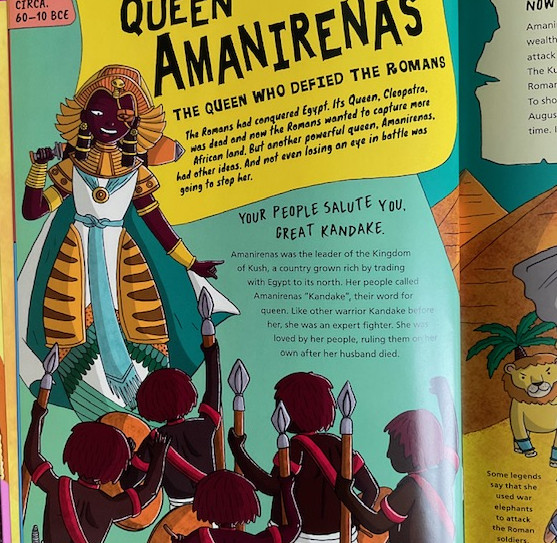
What shines out from all of the legends is that these women each contributed to the history of the countries in Africa and that their stories deserve to be more widely known. I daresay that the author/ illustrator may be preparing to write subsequent volumes as there will certainly be more than twelve such interesting characters to research. The book works well because of the good balance between text and vibrant illustrations with every double page spread being slightly different in design and colour palette.
I strongly recommend this non-fiction book that would be an asset in any classroom for readers of all ages, hopefully to encourage further research about the rich history of the African continent. It is published by Walker Books and should be available from your local independent bookshop, who will happily order it for you if not already on their shelves.
Karen Argent
August 2026